There is a question that keeps coming up in every founder and marketer conversation right now. Someone typed the right keywords, built a decent website, maybe even ranked on page one for a few terms, and then asked ChatGPT about the best brands in their category. Their name did not show up. A smaller, less-known competitor did.
That experience is not a glitch. It is the gap between three different systems of discovery that now run in parallel, each with its own logic, its own trust signals, and its own output format. SEO, AEO, and GEO are not the same thing, with different names. They are genuinely different games. Knowing which one you are actually playing changes how you build your content strategy completely.
This post draws a clean line between all three, and then answers the more practical question: for an Indian brand building from scratch or scaling from early traction, where do you start?
The Three Layers of Search Visibility in 2026
Before going deeper, here is the simplest version of the distinction.
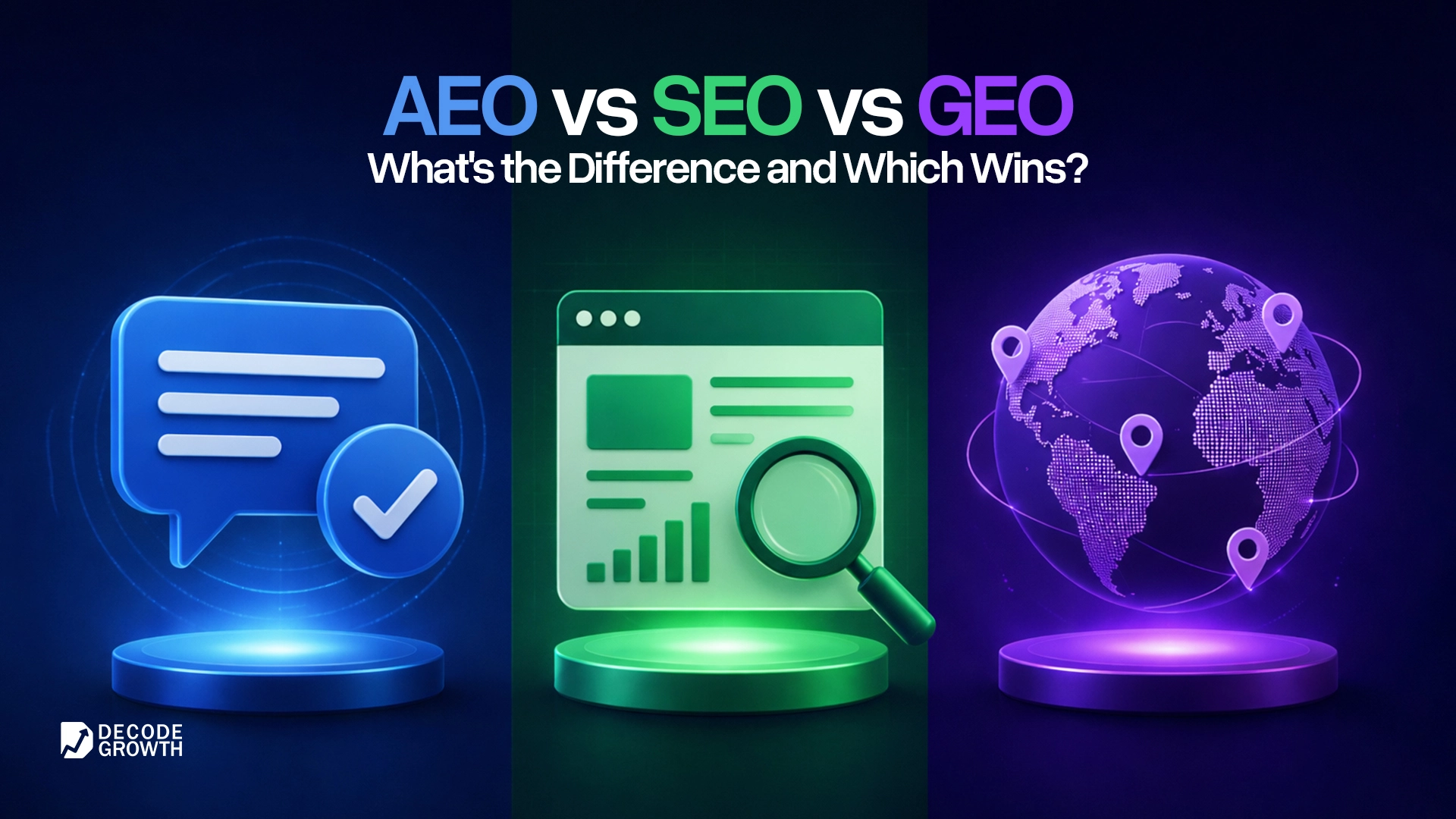
SEO (Search Engine Optimization) gets your web page a ranked position in a list of links on Google or Bing. Someone types a query, sees ten results, and clicks one. Your job is to be in that list, ideally in the top three.
AEO (Answer Engine Optimization) gets your content extracted and surfaced as a direct answer, without the user clicking through. This includes Google’s featured snippets, the People Also Ask boxes, voice assistant responses, and Google’s AI Overviews. The intent behind AEO is different: you are not trying to get a click necessarily, you are trying to be the authoritative answer right on the search page.
GEO (Generative Engine Optimization) gets your brand named inside an AI-generated conversational response when someone asks ChatGPT, Perplexity, Gemini, or any AI assistant a question. There is no list of links. There is no snippet. There is a paragraph that either includes your name or does not.
Three different trust thresholds. Three different mechanisms. And critically, three different content requirements to win.
Why These Are Not Just Buzzwords
The confusion happens because all three involve content, all three involve keywords, and all three are described using the word “optimization.” But the underlying system that reads and rewards your content is different in each case.
With traditional SEO, the system is Google’s crawler and ranking algorithm. It looks at your page’s technical health, keyword relevance, backlink authority, user engagement signals, and E-E-A-T indicators to decide where to place you.
With AEO, the system is primarily Google’s natural language understanding. It reads your content and asks: Does this directly and accurately answer the question someone asked? If your structure is clean, your answer leads the paragraph, and your source signals credibility, you get pulled into the featured snippet or the AI Overview.
With GEO, the system is a large language model that was either trained on web data up to a certain cutoff or is actively browsing the web in real time. It is not ranking your page. It is deciding whether you are a credible, referenced entity worth mentioning when it forms a response. That is a fundamentally different trust evaluation.
About 40 to 60 percent of cited sources change month to month across Google AI Mode and ChatGPT, making AI visibility far less stable than traditional organic rankings. This means GEO is not set-and-forget. It requires consistent authority-building across multiple signals over time.
The Intent Behind Each Layer
This is where most content guides miss the point. They describe what each discipline does, but not what the user’s intent looks like at each layer, which is what should actually drive your strategy.
SEO intent is active and exploratory. The user is looking for options, doing research, or trying to navigate to a specific page. They expect a list. They will click and compare. They are mid-journey in many cases.
AEO intent is immediate and specific. The user wants one clear answer right now. “What is the GST rate on handmade jewellery?” “What are the FSSAI labelling rules for food startups?” They are not browsing. They want the fact, the number, the definition.
GEO intent is conversational and evaluative. “Which D2C skincare brands in India are worth checking out?” “What are the best CA firms in Mumbai for entertainment companies?” This is high-intent recommendation territory. The user is about to make a decision, and they are trusting the AI to shortlist for them.
With SEO, you want position one. With AEO, you want to be the answer displayed above position one. It is the difference between being on the menu and being the recommended dish.
GEO takes it one further: you want to be the dish the waiter recommends before the menu even arrives.
How Each Platform Actually Reads Your Brand
One thing that does not get said clearly enough: ChatGPT, Perplexity, and Gemini do not all work the same way. Treating them as one thing is why most brands get their GEO strategy wrong.
ChatGPT (without browsing) primarily relies on training data. It synthesises information from web content it encountered before its training cutoff. If your brand was consistently mentioned in authoritative sources, listicles, comparison articles, and reputable publications before that cutoff, you are more likely to appear. If your brand is new or thin on third-party mentions, ChatGPT likely does not know you exist.
Perplexity runs a live search for almost every query and cites its sources visibly, usually five to eight citations per response. This makes it the most directly addressable platform for content marketers. Strong SEO and freshly-indexed content can get you cited. Perplexity’s citations are visible to users and drive real, attributable referral traffic.
Gemini is deeply integrated into Google’s ecosystem and draws heavily from organic search presence, structured data, and your overall E-E-A-T signals. If your Google SEO foundation is strong, your Gemini visibility is already partially built.
The Indian Context Nobody Is Talking About Enough
For most Indian businesses in 2026, AEO is the higher-priority discipline because Google holds over 93 percent market share in India, and Google’s AI Overviews and featured snippets are where the majority of answer-box impressions are generated.
That changes the sequence for Indian founders compared to what you might read from US-focused SEO blogs.
In the US, ChatGPT adoption is high enough that GEO is an immediate commercial priority. In India, the funnel still flows heavily through Google. Your customer is more likely to get an AI Overview answer on Google than to open ChatGPT and ask the same question. Which means your AEO strategy, structured data, featured snippet optimization, and Google AI Overview readiness have a bigger short-term return right now.
That said, ChatGPT reached 10 million monthly active users in India by early 2024, and Perplexity is growing rapidly among students, professionals, and researchers, particularly for product research, financial queries, and vendor comparisons. The GEO window is opening. The brands that build now will own the position when it fully arrives.
What Actually Differs in the Content You Write
Here is the practical breakdown most brands need.
For SEO, you are writing for depth, keyword coverage, internal link architecture, and domain authority signals. Long-form content that comprehensively covers a topic. Content that earns backlinks. Content that is technically clean and fast to load. The goal is a ranked page that attracts organic clicks over time.
For AEO, you are writing for structured clarity and immediate answer delivery. Lead with the answer in the first paragraph. Use clear subheadings that mirror how someone would phrase a question. Use FAQ sections with direct, concise responses. Use schema markup so Google can extract your content cleanly. The goal is to own the snippet or the AI Overview block.
For GEO, you are writing for citation worthiness and entity authority. Original data that no one else has. Proprietary frameworks or named methodologies. Third-party references to your brand across credible publications. A consistent entity presence across Crunchbase, LinkedIn, Google Business Profile, and industry directories. The goal is to be trusted enough by an AI system that it names you when forming a recommendation.
The important thing: these overlap significantly. A blog post that leads with a direct answer to a specific question (AEO), uses proper schema and structured subheadings (SEO), and contains original research or a unique perspective (GEO) serves all three layers at once. That is what a modern content brief should target.
Which One Should Indian Brands Focus on First
The honest answer is that it depends on where you are, but there is a sensible sequence for most brands.
Start with SEO fundamentals. Without a technically healthy, well-structured website and some keyword authority, neither AEO nor GEO has a foundation to build on. AI systems primarily reference content that already ranks. You cannot skip this step.
Layer AEO into your content immediately. This means restructuring your existing blogs so the most important answer appears in the first paragraph. Adding FAQ schema. Targeting People Also Ask questions in your category. For Indian brands, this has the highest near-term return because Google AI Overviews are already influencing how your customers discover information.
Build GEO signals as a longer-term play. Get your brand listed in credible directories: Crunchbase, Tracxn, Startup India, Inc42. Earn third-party coverage in publications that AI systems treat as authoritative. Build your review volume on Google, G2, or Amazon, depending on your business model. Publish original data or research that is attributable to your brand. This does not happen in a week. But it compounds.
Unlike traditional SEO, where shortcuts sometimes worked, in AI-driven search, the quality and reliability of your content is truly paramount, giving high-quality content creators a genuine structural advantage.
The Measurement Problem Nobody Solves for You
Most Indian brands have no visibility into how they perform across all three layers right now, and that is fixable without expensive tools.
For SEO: Google Search Console tells you which queries you are ranking for and what your click-through rate is. That is your baseline.
For AEO: Search for your target keywords in Google and check whether you appear in the featured snippet, People Also Ask, or AI Overview. This is a 15-minute manual audit you can do today.
For GEO: Open ChatGPT, Perplexity, and Gemini. Ask the questions your customers would ask about your category. See if you are named. Note which competitors appear. Then look at what those competitors have that you do not: more reviews, more publication coverage, a Wikipedia presence, and stronger Crunchbase profiles. That gap analysis is your GEO roadmap.
In Google Analytics 4, filter for sessions from chatgpt.com, perplexity.ai, and gemini.google.com. That is your AI referral traffic today. Track it monthly. It will grow.
The Bigger Picture
Search has become a set of parallel conversations happening across different systems at once. Google is still where most of your Indian customers start. But where they end up, and what validates their decision, increasingly includes an AI interface that either knows your brand or does not.
A brand can rank well and still be invisible where decisions are actually made.That is the core problem that SEO alone can no longer solve.
The brands that understand all three layers and build content and authority structures that serve all three simultaneously will not just rank higher. They will be the ones named in the conversations that precede the purchase.
You are not choosing between SEO, AEO, and GEO. You are building a visibility architecture that works at every point where a potential customer might encounter your category. The sequence matters. The prioritisation for your specific context matters. But the destination is the same: being the brand that is found, trusted, and recommended regardless of how someone searches.
If you want your brand to be part of it, Decode Growth helps you build that foundation with SEO, AEO, and GEO approach designed for how search actually works today.
FAQs
SEO gets your website ranking on Google. Simple enough. AEO takes it further by getting your content into featured snippets or the AI Overview box at the top of results. GEO is where things get interesting. It is about getting your brand named inside an actual AI conversation on ChatGPT or Perplexity. The AI is essentially recommending you, not just listing you. That is a completely different trust level and honestly, a much bigger opportunity right now.
India is already the second biggest market for ChatGPT globally. That is not a future prediction, that is happening right now. What surprises most founders is that category leaders in AI responses have not been decided yet for most Indian industries. No one has claimed that space in ed-tech, D2C, or B2B SaaS. Brands that build their AI presence this year will become the default recommendation in two years. That kind of early positioning is very hard to displace once it sets in.
ChatGPT reads top-ranking comparison articles on Google and builds its answers from them. If your brand is missing from those roundups, ChatGPT likely does not know you exist. Perplexity runs a live search for every query and shows its sources directly, usually around six to eight citations. Gemini leans on Google’s index heavily. Across all three platforms, what consistently matters is how many credible, independent sources mention your brand and whether those mentions actually say something specific and meaningful about what you do.
Open ChatGPT right now and type the question your customer would ask. Something like “best HR software for Indian startups” or “good D2C skincare brand for oily skin in India.” Check if you appear. If you do not, look carefully at who does and study their digital footprint. Most of the time those brands have press coverage in Inc42 or YourStory, a filled-out Crunchbase profile, and decent review counts on Google or G2. That gap analysis is genuinely the most useful starting point.