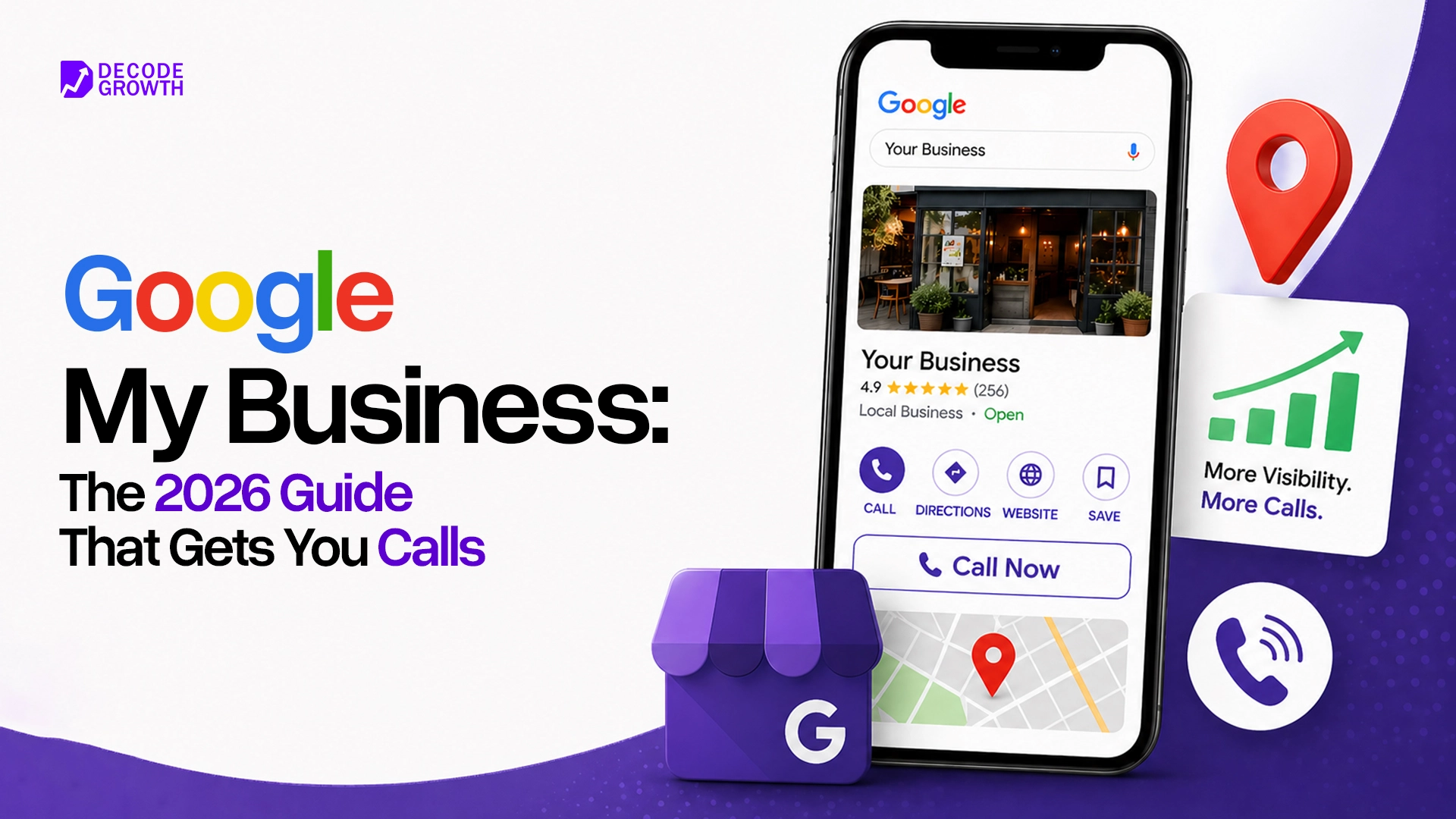
If you run a service business in Delhi, Gurugram, Mumbai, Bangalore, or any city and you are not getting calls from Google, there is a very good chance your Google Business Profile is the problem.
This guide walks you through how local search actually works in India and what you need to do inside your Google Business Profile to show up when customers are ready to take action.
Why Google Business Profile Is Your Most Important Marketing Asset in 2026
44 percent of all local search clicks go to the Local Pack, which is the three map results you see at the top of a Google search for a service or location. Google Business Profile is also the primary source for voice search answers.
Your website cannot get you into that local pack on its own. Your GBP is what Google evaluates. A well-optimised profile directly drives calls, WhatsApp messages, and direction requests from people who are already looking for exactly what you do.
Indian users rely heavily on map results, local packs, and quick business details while searching on mobile. Many business owners still think listing their name and phone number is enough. Google now evaluates activity, accuracy, engagement, and trust signals before showing a business prominently.
Let’s fix that, section by section.
Getting Verified: The India-Specific Reality
Verification is where many Indian service businesses get stuck. Google offers several methods, and in India, the fastest available option is always worth taking immediately.
If you run a service area business (think: event planner, home cleaning service, plumber, digital marketing consultant) and do not have a fixed commercial address, set up your profile as a Service Area Business.
You can hide your physical address and instead specify the areas you serve. This is underused by Indian service businesses that either list a home address they should not share publicly, or skip GBP entirely because they assume it requires a shop.
Categories: The Decision Most Indian Businesses Get Wrong
Your primary category is the single most important field in your GBP. Google uses it to decide which searches you are eligible to appear in. Getting it wrong is a top reason why businesses sit at position seven in the local pack when they should be in the top three.
Choose the most specific primary category available, not the broadest. A GST consultant who selects “Financial Planner” as their primary category will lose to a competitor who selected “Tax Consultant” because that is the more accurate match for “GST consultant near me” searches.
Changing your primary category triggers a re-evaluation by Google and can shift local pack positions within two to four weeks, either upward or downward. Before making category changes, check which category your top-ranking local competitors are using. If three businesses outranking you are all using a specific category and you are using a broader one, that is your first fix.
Add secondary categories to expand the range of queries you can appear for. A CA firm can list “Tax Consultant,” “Accounting Firm,” and “Auditor” as secondary categories in addition to their primary, giving them eligibility across a much wider set of local searches.
The Description: Where Keywords Actually Live
Your GBP description is 750 characters. Most Indian businesses write something generic like “We provide quality services with 10 years of experience.” That is a wasted ranking opportunity.
Write your description the way a potential customer would search for you. Include your city, your locality, your service type, and any specific niche. “We are a Gurugram-based digital marketing studio serving D2C brands and local businesses across Delhi NCR. We specialise in SEO, Google Ads, social media management, and brand strategy for Indian founders building from the ground up.”
Every specific phrase in that description is a local keyword signal. Locality name, service type, niche audience, all feed directly into what queries you can show up for.
Photos: Volume, Freshness, and What Indian Businesses Should Actually Upload
Upload a minimum of 30 photos. Post weekly updates to keep your profile active. But the type of photos matters more than most guides explain.
For Indian service businesses, what works: photos of your workspace (clean, well-lit), your team in action, project work or before-and-after results if applicable, your logo and signage, and screenshots of actual client feedback that can be used as photo posts. Google weighs photo freshness as an engagement signal. Profiles that have not uploaded a new photo in six months look abandoned to the algorithm.
Upload photos with descriptive file names before uploading. “digital-marketing-agency-gurugram.jpg” is a keyword signal. “IMG_4052.jpg” is not.
The WhatsApp Integration That Changes Your Conversion Rate
This is the single most India-specific GBP tactic, and almost no guide covers it properly.
The most effective CTA for converting Google Business Profile Post viewers into actual conversations is directing them to WhatsApp. Use a pre-filled message URL structured as wa.me/91XXXXXXXXXX with a pre-typed message and set the button type to “Learn More.” Customers who tap it land directly in a WhatsApp chat with a message already typed, removing every friction point between seeing your post and starting a conversation.
This works because Indian customers are already on WhatsApp. Asking them to fill a contact form or call during business hours creates friction. A tap that opens a pre-filled WhatsApp message to your number eliminates that friction entirely.
Add this to every Google Post you publish. Seasonal posts, especially an AC repair service in Delhi posting “Pre-summer servicing slots open for April, limited availability” with a WhatsApp CTA, will convert significantly better than the same post with just a phone number.
Reviews: The Strategy That Actually Moves Rankings
The top three local pack results average 47 reviews, but a business with 20 genuine, recent, keyword-rich reviews can outrank one with 200 old, generic reviews.
This is the most important review insight for Indian service businesses because most have either very few reviews or a batch of old ones with no recent activity. Freshness and specificity beat volume.
Ask for reviews within 24 to 48 hours of completing a service, when satisfaction is highest. Share the direct Google review link from your GBP dashboard, not just “please leave a review on Google.” Make it one tap.
When you ask, subtly guide the content. “If you could mention the specific service we helped you with and which area you are based in, it helps other people find us.” A review that says “Great interior design work in Hauz Khas, Delhi” is a local keyword signal. “Good service” is not.
Respond to every review, positive and negative, within 48 hours. Use the response to naturally include the service type and locality. “Thank you for trusting us with your brand’s SEO in Connaught Place” is an organic keyword signal inside a review response.
Google Posts: Treat Them Like Instagram Stories With Business Intent
Google Posts expire after seven days if you set no end date on an event, or stay live as updates. Most Indian businesses either never post or post once and forget.
Post at a minimum twice a week. Alternate between: an update about your service or a seasonal angle, a client result (anonymised if needed), and a direct offer or consultation CTA.
Seasonal service posts generate significant WhatsApp enquiries because they match what customers are already thinking about. A CA firm posting “ITR filing for freelancers and consultants starts now” in June, linked to a WhatsApp CTA, will generate inbound enquiries from people who are already looking for a CA at that exact moment. Timing matters.
NAP Consistency: The Citation Signal Most Indian Businesses Ignore
NAP stands for Name, Address, Phone. Your business information should be identical, character for character, across your GBP, your website’s footer, Justdial, Sulekha, IndiaMART, IndiaBizForum, and any other directory you are listed in.
“Decode Growth Studio” on GBP and “Decode Growth“ on Justdial are technically different entities to Google’s algorithm. Inconsistencies dilute your local authority and confuse the systems that aggregate local signals. Audit all your listings once a quarter and fix any discrepancies.
Service Area Business Nuances for Delhi and NCR
If you serve multiple Delhi localities or across Delhi NCR (Delhi, Gurugram, Noida, Faridabad, Ghaziabad), set your service areas to match. Include the specific city names and major localities your clients come from.
When writing your services section inside GBP, add each service as a separate line item with a brief description. “SEO for Local Businesses: We help Delhi NCR businesses rank in Google Maps and local search results through Google Business Profile optimisation and citation building.” That description is indexed and becomes a signal for hyper-local queries.
Do not try to cover every city in India on one profile if you are actually a local service business. Google’s local algorithm rewards relevance and proximity. Specificity to your actual service area will outperform a profile that claims to serve everywhere.
What a Fully Optimized Profile Actually Looks Like
Here is the practical checklist: profile 100 percent complete with every section filled, primary category set to the most specific option available, secondary categories added, description with city and service keywords written naturally, minimum 30 photos uploaded with fresh additions weekly, reviews above 4.5 rating with recent and keyword-rich content, Google Posts active at least twice per week with WhatsApp CTAs, service area set to your actual coverage zone, and NAP consistent across all directory listings.
Conclusion
Most Indian service businesses are not losing customers because of poor service. They are losing them because they are not visible at the exact moment intent exists.
Local search is not about who has the best website. It is about who shows up first when someone nearby is ready to take action. That decision is being made inside the local pack, inside your Google Business Profile, and increasingly inside AI-generated summaries that pull directly from it.
The difference between a profile that sits idle and one that consistently generates calls is not complexity. It is consistency. Small, repeatable actions like updating photos, responding to reviews, posting weekly, and structuring information correctly compound into visibility.
And in a market like India, where most businesses still treat GBP as a one-time setup, that consistency becomes an unfair advantage.If your profile is not driving calls or WhatsApp enquiries yet, the gap is not permanent. It is operational. Decode Growth works with service businesses to turn their Google presence into a predictable inbound channel, built around how local search and AI discovery actually work today.
FAQs
No fixed number guarantees a top-three spot, and chasing a target figure is the wrong approach anyway. What Google rewards in 2026 is steady, recent activity. Ten genuine reviews coming in monthly will outperform a competitor sitting on 200 reviews collected two years ago. When asking customers, nudge them to mention the specific service and their locality. That combination of recency and natural keywords is what quietly shifts your position over time.
Plenty already do. You set the profile up as a Service Area Business, keep your home address hidden, and define the localities you genuinely cover. Freelancers, tutors, plumbers, event planners across Gurugram, Noida, Faridabad and Ghaziabad are ranking this way right now without a commercial address. Just keep your service area grounded in reality. Claiming you serve every city in India on a single profile will hurt more than it helps.
Twice a week works well for most businesses once you build the habit. What matters more than frequency is relevance. A Delhi AC repair service posting about pre-summer slots in March, with a WhatsApp link that opens a pre-typed message, will pull real enquiries. Profiles that post consistently, respond to reviews promptly, and update their information regularly have shown steady ranking gains over months. Google notices the activity even when customers do not explicitly see every post.
There may be a short wobble of a few weeks while Google reassesses your profile against the new category. That is fairly normal. The more important question is whether staying in a broad or mismatched category is costing you searches every single day right now. A GST filing service listed under Financial Planner bleeds relevant traffic quietly and consistently. Check what category your top three local competitors are using before making any change, and if a more specific option fits your work better, the temporary dip is worth taking.
Verification confirms your profile exists. Consistency across the wider web tells Google your business information is reliable and trustworthy beyond just your own listing. When your name reads “Sharma and Co.” on Google, “Sharma & Co” on Justdial, and “Sharma Co.” on Sulekha, the algorithm treats those as separate unrelated entities rather than one credible business. That fragmentation chips away at your local authority without making any noise. A quick audit of your major Indian directory listings every few months catches these discrepancies before they quietly drag your rankings down.