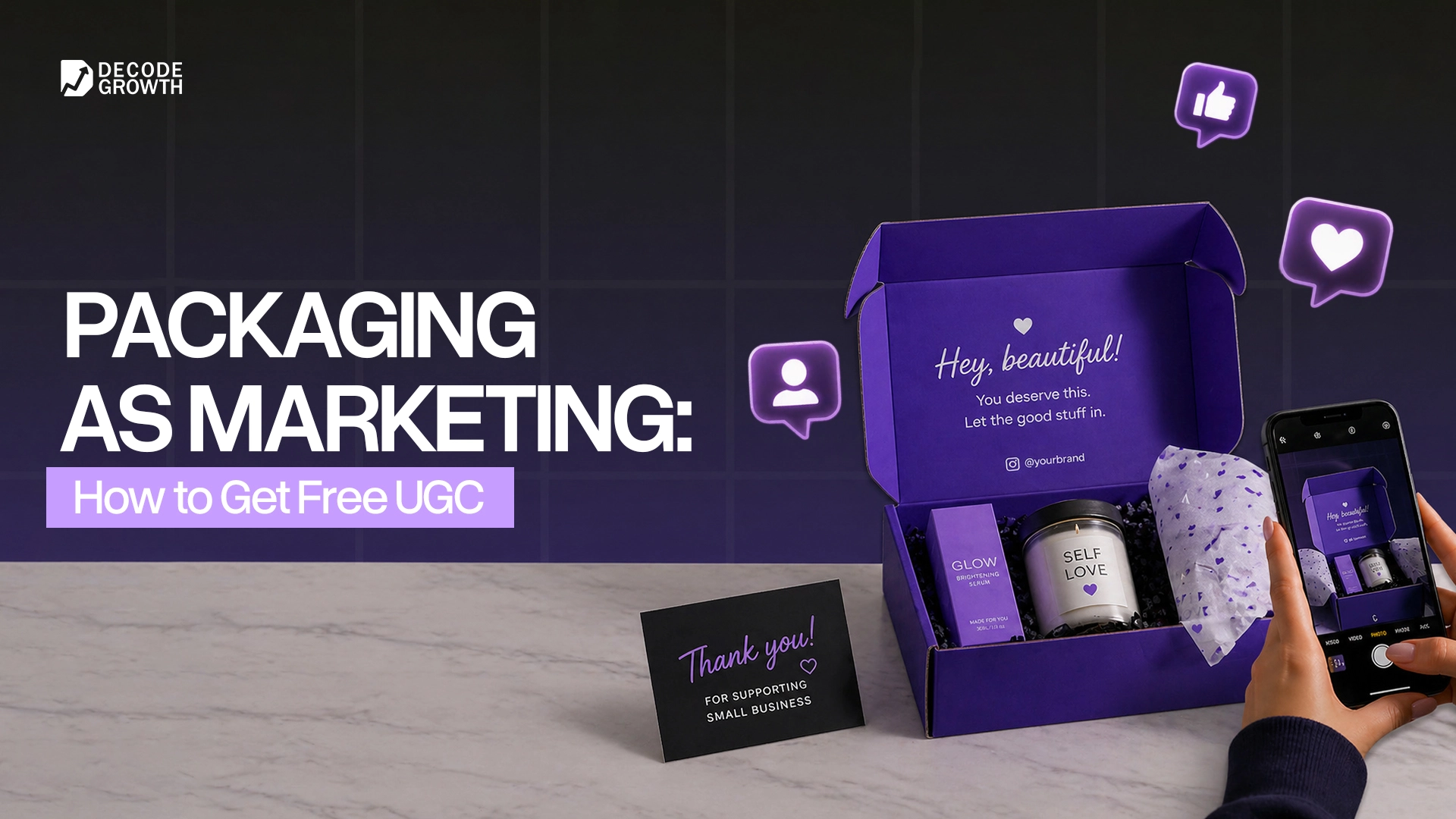
There is a box sitting on someone’s dining table right now. They ordered something from a brand they saw on Instagram three days ago. Their phone is already out before they have even cut the tape.
That moment, between the box arriving and the product coming out, is one of the most underutilised marketing assets in Indian D2C. And the brands that understand it are getting thousands of rupees worth of organic content created by their own customers, for free, every single day.
This is the business case for packaging as marketing. Not just pretty boxes. Not just your logo on brown cardboard. A deliberate, strategic unboxing experience designed to make someone want to share it.
Why Packaging Is a Growth Channel, Not Just a Cost
Most early-stage Indian D2C founders think about packaging in one of two ways: functional (does it protect the product?) and brand-visible (is our logo on it?). Both matter, but they are the floor, not the ceiling.
The ceiling is what happens when packaging creates a moment worth sharing.
Brands like mCaffeine, Plum, The Ayurveda Co., and Pilgrim have figured this out. Their packaging is designed to photograph well, feel premium, and often includes a physical element that makes the customer feel seen: a handwritten note, a personalised tag, a tissue paper wrap in a signature colour, a QR code that leads somewhere surprising.
What follows is a social post. Or a Reel. Or a WhatsApp message sent to a friend. All of it unprompted. All of it earned.
For a brand spending ₹300 to ₹600 per customer acquired through Meta ads, a single organic share that reaches 500 followers of that customer is worth meaningful money. Multiply that across hundreds of orders a month, and you have a UGC engine running inside your logistics.
What Makes an Unboxing Actually Shareable
Not all nice packaging gets shared. The brands getting consistent unboxing content from their customers are doing specific things that trigger the sharing instinct. Here is what those things are.
Unexpected sensory detail
The packaging looks premium, but the real moment is tactile. It is the weight of a thick paper box, the matte finish on a sticker, the subtle scent of the tissue paper, and the sound of a magnetic closure. Sensory details signal quality in a way that photographs alone cannot, and they create an experience the customer wants to describe to others. “You have to feel this box” is a message that drives curiosity.
A personal element at scale
It does not have to be literally handwritten for every order. A printed card that says “Hey [Customer Name], this one is for you” with a genuinely warm message creates a feeling of personalisation even if it is printed at volume. Some brands include a small handwritten note in every order. Even at 50 orders a day, that is doable, and the impact is disproportionate.
Something unexpected inside
A small unexpected gift. A sample of a complementary product. A sticker. A seed packet from an eco-conscious brand. A discount code on a beautifully printed card rather than a generic coupon. The surprise element is what tips someone from “this is nice” to “I have to show someone this.”
Photography-friendly design
This sounds obvious, but most Indian D2C packaging is not actually designed for phone cameras. Flat lays with your packaging should look good without a professional setup. That means clean colour palettes, legible typography at close range, and a layout that reads well in a square or portrait crop. If your packaging looks great in a dim apartment on a phone camera, you have cleared the bar.
An explicit invitation to share
Many brands still skip this. A small line on the box, a card inside, or a sticker that says “Show us yours” with your Instagram handle and a hashtag does two things: it gives permission, and it gives direction. Customers who were already going to share now know where to tag you. Customers who were on the fence are nudged over.
The Business Case in Numbers
Let us put some rough numbers to this for a mid-size Indian D2C brand shipping 500 orders a month.
If even 5% of customers share an unboxing organically (and with the right packaging design, this is conservative), that is 25 posts a month. If the average Instagram account of a customer reaches 400 to 600 followers, that is 10,000 to 15,000 impressions from earned media per month.
At a typical CPM of ₹150 to ₹250 on Instagram paid, you would pay ₹1,500 to ₹3,750 for that reach through ads. But with great packaging, you earn it through the experience itself.
Beyond reach, UGC also drives conversion. Ads using real customer content convert 4 to 6 times better than branded ads in most D2C categories. So the content being created by customers who share their unboxing is also your best creative asset for paid performance.
The additional packaging cost to create this experience, done thoughtfully, is often ₹15 to ₹40 per order. The return, in earned reach, UGC, and word-of-mouth, vastly outweighs the investment.
What Indian D2C Brands Are Actually Doing Right Now
A few real examples of what is working in the Indian market.
Personalisation at checkout that shows up in the box
Some Shopify brands in India are now using post-checkout flows where customers can write a message (usually for a gift), and that message is printed and included in the order. The recipient shares the unboxing. The gifter shares the unboxing. Two pieces of UGC from one order.
Eco packaging that tells a story
Brands in the wellness, skincare, and food categories are winning on eco packaging not just because it feels good but because customers who care about sustainability want to show others that they are making responsible choices. A beautifully designed compostable box or a reusable tin is something people are actively proud to show.
QR codes that lead somewhere worth going
Not a generic website. A QR code on the inside of the box that takes the customer to a personalised thank-you video from the founder, or a behind-the-scenes look at how the product was made, or a playlist the brand curated for using the product. This creates another reason to take the phone out during unboxing, and another moment worth sharing.
Packaging that doubles as décor
A few Indian candle, jewellery, and homeware brands are designing boxes that customers genuinely want to keep. When the packaging is beautiful enough to sit on a shelf, it gets photographed repeatedly, not just once.
Where Most Indian D2C Brands Are Leaving UGC on the Table
Here is what the packaging of most Indian D2C brands looks like right now: a brown or white mailer box with a printed logo sticker, standard void fill or plastic bubble wrap, a generic invoice, and sometimes a discount code on a flimsy slip.
That experience communicates one thing: “We shipped you the product.” It does not communicate brand love, care, or any reason to share.
The gap between that experience and a shareable one is not as expensive as most founders assume. The biggest cost is not material, it is design thinking. It is asking the question: what do we want the customer to feel in the first 60 seconds of receiving this order, and what do we want them to do next?
Once you answer that question with clarity, the packaging decisions become tactical rather than guesswork.
The Unboxing Experience as Part of Your Customer Acquisition Cost
Here is a reframe that changes how you think about packaging investment.
If your current packaging generates zero organic shares, your entire customer acquisition is funded by paid ads. Every new customer costs you something from your ad budget.
If your new packaging generates 100 organic shares a month, each one reaching 500 people on average, you have added 50,000 monthly impressions of earned media. Some percentage of those people become customers without you spending a rupee on them.
That means your packaging improvement is not just a cost line. It is a partial substitute for ad spend. The brands that think this way invest meaningfully in the experience and track UGC as a business metric, not just a nice-to-have.
How to Start Without Redesigning Everything
You do not need to redesign all your packaging at once. Here is a phased approach that works for lean D2C teams.
Start with the insert. A beautifully designed card inside your current box costs almost nothing to change and can include a personalised message, your Instagram handle, a sharing prompt, and a QR code. This alone can meaningfully increase organic shares.
Then address the unboxing sequence. What does the customer see when they open the box? Is there a layer of tissue in a signature colour? Is there a scent? Is there an unexpected small gift or sample? This layer of experience is usually low-cost and high-impact.
Finally, invest in outer packaging once you have a packaging direction you know works. Changing the box or mailer is the biggest investment, but by the time you get there you will have data from your inserts on what customers respond to.
Tracking Your Unboxing UGC
If you are going to invest in packaging as a marketing channel, you need to track what comes back.
Set up a branded hashtag and monitor it weekly. Track mentions and tags on Instagram. Use a tool like Sprinklr, Mention, or even just Instagram’s native tagged posts feature. Count the number of organic unboxing posts per month and treat it as a KPI.
Also track review velocity. Brands with great unboxing experiences tend to get more reviews faster, because the customer is in a sharing mood right after opening the order. The unboxing moment and the review moment are often the same moment.
Over time, you will be able to calculate roughly how much earned media your packaging is generating, and whether that number is growing as you improve the experience.
Decode Growth and D2C Brand Experience
At Decode Growth, packaging strategy sits at the intersection of brand design and growth marketing. We work with Indian D2C brands to design unboxing experiences that are not just beautiful but measurably effective at generating UGC and word-of-mouth.
If your packaging is currently just a box with your logo on it, there is significant unrealised growth sitting inside your logistics operations.
Talk to us about your brand experience
Frequently Asked Questions
Increasingly, yes. The urban Indian consumer in the 22 to 35 bracket, particularly in metros, responds positively to eco-conscious packaging. It signals brand values, gets photographed more often (because customers want to show they are making responsible choices), and creates PR and partnership opportunities. The cost of sustainable packaging has also come down significantly in India over the last two years.
Include a clear, friendly prompt inside the box. Something like “Share your unboxing and tag us @[handle] for a chance to be featured” or a hashtag with a printed card that says “Show us yours.” Make it easy by including your Instagram handle prominently. The brands that ask directly get 3 to 5 times more organic shares than the ones that assume customers will figure it out on their own.
Brands like mCaffeine, The Whole Truth, Mamaearth (especially their early gifting sets), The Ayurveda Co., Pilgrim, and Bombay Shaving Company have invested meaningfully in packaging design. Each has built brand recognition partially through the quality of their physical touchpoints.
Yes, significantly. Research across D2C brands globally shows that customers who describe the unboxing as a positive experience are 40 to 50% more likely to reorder. In the Indian market, where brand trust is often built through perceived care and quality, the unboxing experience is a direct signal of both.
There is no universal number, but for most categories in India, an additional ₹20 to ₹60 per order invested in experience-focused packaging has a strong positive return when measured against the UGC and word-of-mouth it generates. The right number depends on your average order value and your current CAC.