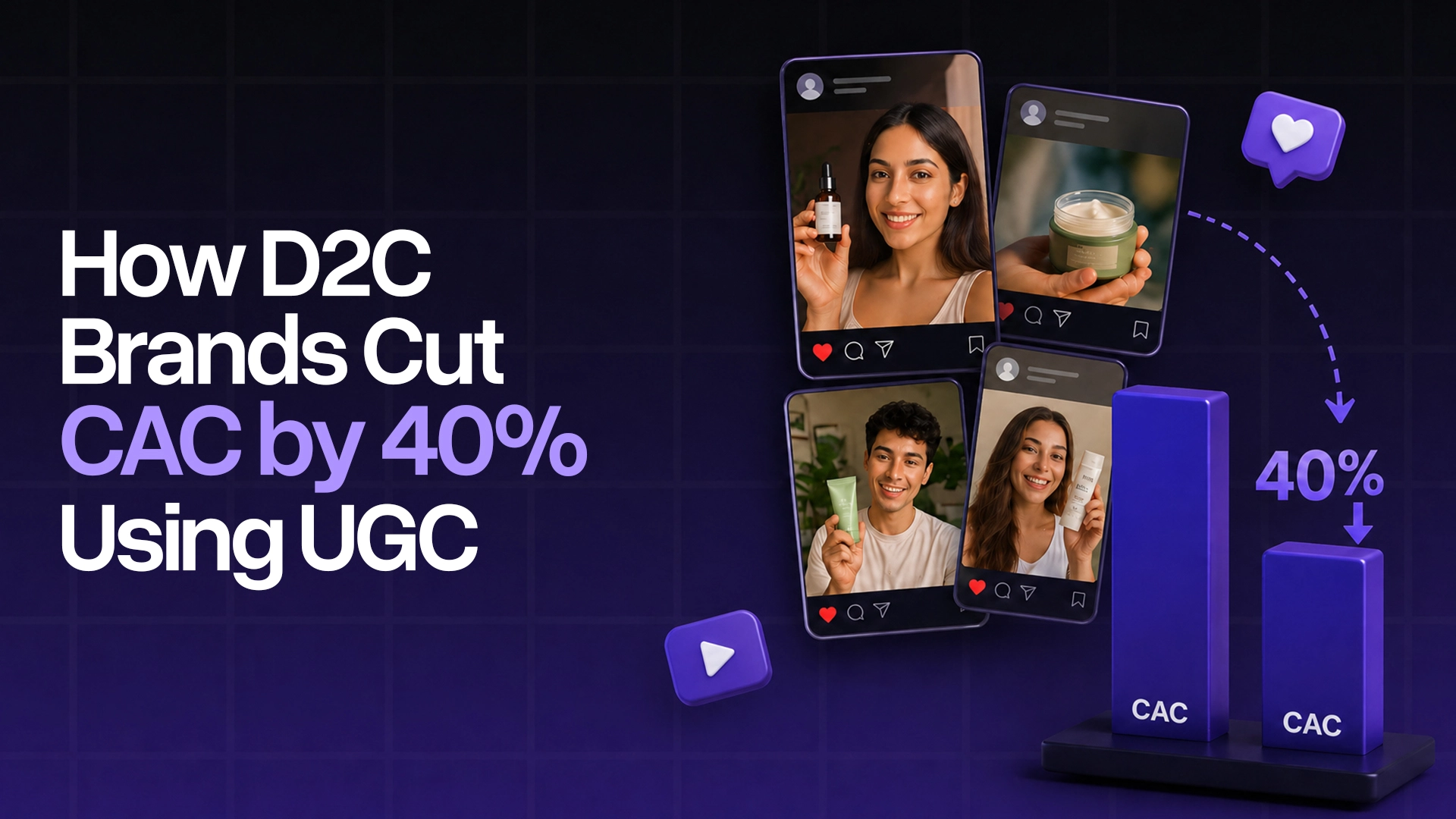
Yes, it is actually happening. D2C brands across India are quietly replacing expensive influencer campaigns with UGC marketing, and the ones doing it right are seeing their customer acquisition cost drop by 30 to 40%. If you have been watching your Meta ad costs climb every quarter and wondering why that polished Reel with a popular influencer barely moved the needle, this blog is written for you.
The CAC Problem Nobody in Indian D2C Talks About Honestly
There is a very specific kind of frustration that D2C founders know well. You pour money into a campaign, get decent reach numbers, and then open your dashboard to see that your cost per purchase went up again. It feels like the rules of the game keep changing. And honestly? They did.
You Are Not Imagining It. Ads Really Did Get More Expensive.
By 2024, India had more than 800 active D2C brands. Most of them were running ads on the same Meta and Google inventory. More brands bidding on the same audiences means CPMs go up, your rupee reaches fewer people, and your ROAS shrinks. That is just auction mechanics. On top of that, the iOS privacy changes that started in 2021 degraded targeting accuracy on Meta to a point where your lookalike audiences are less precise than they used to be, and your retargeting pools got smaller.
The result? Customer acquisition costs in India’s D2C space have risen by roughly 30% year on year according to multiple market reports. And in beauty and personal care specifically, digital CAC on platforms went up over 60% in just three years. That is not a bump. That is a structural problem that requires a structural fix, not just a bigger ad budget.
What Influencer Marketing Actually Costs Indian D2C Brands in 2025
Here is something brands rarely put a hard number on. A mid-tier Instagram creator with 200k to 500k followers charges anywhere from Rs. 50,000 to Rs. 3,00,000 for a single Reel. You get one piece of content, a window of maybe 48 to 72 hours of decent visibility, no guaranteed conversions, and you do not own any rights to reuse that content in ads without paying extra.
Now compare that to hiring a UGC creator. These are people who shoot product content specifically for your brand to use in paid ads. They charge roughly Rs. 5,000 to Rs. 15,000 per video, you get full usage rights, and you can run it as an ad for months. The math is not even close.
Influencer rates have also climbed 25 to 30% annually while engagement rates on sponsored posts have been quietly falling. Dabur India’s digital head Jasleen Kaur Kohli put it well when she said there is still no standard pricing benchmark, no common denominator across platforms, and attribution tracking remains all over the place. Brands are paying premium prices without being able to clearly measure what they got for it.
Why Polished Ads Are Losing to Shaky Phone Videos
This one takes people by surprise. A studio-shot ad with perfect lighting, a celebrity or influencer, and a professional edit should logically perform better than a video someone shot in their apartment bathroom. Except it does not. Not anymore.
Sugar Cosmetics noticed this and adjusted their entire creative direction. Highly polished influencer ads were losing impact with modern Indian consumers. What was working instead was honest, unfiltered content from real people. Snitch, the Bengaluru fashion brand, has spoken publicly about how UGC and community reactions on Reels outperform their high-production brand films in reach and engagement. Delicut, a healthy meal delivery brand, switched from studio shoots to vertical UGC-style creative and watched their cold-traffic ROAS go from 1.8x to 3.4x in 90 days. Same product, same audience, same offer.
The reason this happens is not magic. It is psychology. Consumers in 2025 have seen thousands of sponsored posts. They know what paid content looks and feels like. When they see something that looks real, it registers differently in their brain. It feels like advice from a friend rather than an ad.
What UGC Actually Is and What It Is Not
Before getting into the strategy side, it is worth clearing up some confusion here because a lot of people use the term loosely and end up building the wrong thing.
The Difference Between UGC and Influencer Content
UGC, or user-generated content marketing, broadly refers to content created by real customers or creators that looks and feels like an authentic personal experience with a product. This includes phone-shot unboxing videos, before-and-after skincare results filmed in natural light, honest reviews recorded at a desk, or a quick Reel showing how someone actually uses a product in their daily routine.
Influencer marketing is different. You are paying for someone’s audience. They post to their followers, you get visibility. UGC creators, on the other hand, produce content that you use on your own brand channels, your product pages, and in your paid ads. They do not need 200k followers. They need to be able to create content that feels real and converts. The whole orientation is different, which is why the economics are completely different too.
Why Indian Buyers Trust Real People More
India is a word-of-mouth market at its core. Before an Indian consumer spends money online, especially on a D2C brand they are discovering for the first time, they want validation. They want to know other people bought this, used it, and were happy with it. That is why reviews on Flipkart, Meesho, and Amazon India carry so much weight. It is the same reason WhatsApp forwards from family members drive so many purchase decisions.
When a D2C brand puts UGC content in front of a prospective buyer, they are essentially replicating that friend-recommendation feeling. Fixderma understood this well. Their UGC-style content of real people documenting their skin journeys over weeks outperforms everything else they run in terms of organic traction. When a real person talks about a dark neck or rough elbow on camera and shows their results, it lands in a way that no brand video ever can.
The Numbers That Make Brands Switch
Some data points that are worth sitting with before moving on. UGC on product pages increases conversions by 161%. Ads with UGC get 4x higher click-through rates compared to standard brand creatives. UGC reduces cost per click by 50% compared to traditional creative. And 92% of Indian consumers trust peer recommendations over brand advertising.
One more thing worth noting: UGC is considered 8x more impactful than influencer content in actual purchase decisions, according to research from inBeat Agency, not in reach. At the moment someone decides to buy. That is the bottom of the funnel, and that is exactly where your CAC math gets solved or broken.
How Indian D2C Brands Are Actually Using UGC in Their Ads Right Now
Knowing why UGC works is useful. Knowing how the brands winning with it are actually doing it is more useful.
The Sugar Cosmetics and Fixderma Lesson
Sugar Cosmetics built a large part of its early growth through authentic micro-influencer content and real community engagement. Not celebrity ads, not big production campaigns. Content that showed real women with Indian skin tones actually using the products. The brand went from nothing to crossing hundreds of crores in revenue, and their core brand-building strategy was always rooted in real voices over polished messaging.
Fixderma’s approach is even more instructive for smaller brands. Their UGC strategy is essentially built around customers documenting their actual skin progress. Before-and-after content filmed over weeks, in normal lighting, with honest commentary. This content drives their strongest organic traction and helps them build trust in a category, dermatology skincare, where credibility is everything. They are not paying a celebrity to endorse them. They are letting their actual results speak through real customer experiences.
UGC in Performance Ads: What Is Working in India in 2026
Based on testing data across 30-plus D2C brands tracked by performance marketing firms operating in India, UGC-style vertical creative outperforms studio-polished ads for cold traffic acquisition by 1.4x to 2.1x in ROAS. That is a significant gap. The winning format is vertical 9:16 video, product visible within the first two seconds, a clear problem-solution narrative, and a hook that stops the scroll in the first 1.5 seconds.
The brands cutting CAC through this approach are not running one or two UGC ads. They are producing 15 to 20 creative variations per month, testing different hooks, different narrators, different product angles. When the Meta algorithm finds the combination that converts best, it optimizes toward it automatically. You are essentially giving the algorithm more material to work with, which reduces your cost per acquisition over time.
Where to Actually Place UGC Content for Maximum Impact
Running UGC only in paid ads is leaving money on the table. Here is where the brands doing this well are placing their content. On product detail pages, embedded customer video reviews and real photos lift conversion rates significantly because buyers at that stage want proof, not promises. In email campaigns, a section showing real customer experiences gets far better click-through rates than standard promotional copy. In Reels and Shorts, reposted customer content or brand-owned UGC builds a feed that feels like a community rather than a brand brochure. In retargeting ads specifically, UGC testimonials work because someone who already visited your site needs a final nudge of social proof, not another awareness-level brand message.
Building a UGC Marketing Strategy for Your D2C Brand From Scratch
This is where most blogs get vague and unhelpful. Here is something more concrete.
Step 1: Get Content From Your Own Customers First
Your existing customers are the most credible source of UGC you have and most brands never even ask. Set up a post-purchase email or WhatsApp sequence that goes out 10 to 14 days after delivery, after the customer has actually used the product. Ask them to share a photo or a short video. Offer a 10% discount on their next order or early access to a new product in return. Most people who genuinely like what they bought will do this for a small incentive.
Put your branded hashtag on every packaging insert, in every order confirmation, and in your Instagram bio. Feature the best submissions publicly and loudly. People love being acknowledged by brands they support. This creates a positive loop where more customers share because they see others being featured.
Step 2: Work With UGC Creators, Not Influencers
Once you want to move faster and build a content library specifically for ads, start hiring UGC creators. These are content creators who make videos for your brand to run on your channels. They are not posting to their own followers. Look for them on platforms like Wobb or direct Instagram outreach by searching in your product category. Give them the product, a clear brief covering the problem your product solves, who the target customer is, and what a good result looks like. Let them bring their own natural voice.
At Rs. 5,000 to Rs. 15,000 per video, you can build a library of 10 solid ad creatives for under Rs. 1,50,000. That is less than what most brands spend on a single mid-tier influencer collaboration that produces one piece of content.
Step 3: Test Fast and Scale What Works
This is the part where the customer acquisition cost reduction actually happens. Take your UGC library into your Meta ad account and run multiple variations simultaneously with small daily budgets of Rs. 500 to Rs. 1,000 per ad. Watch the CTR, cost per click, and cost per purchase after 5 to 7 days. Kill what does not perform. Double budget on what does. Rotate in new creatives monthly to prevent ad fatigue.
The brands seeing 30 to 40% CAC reduction are not doing anything exotic here. They are just running more creative tests with lower-cost UGC content, which means they can afford to fail faster and find winners faster.
Step 4: Measure the Things That Actually Matter
Track your blended CAC monthly, meaning total marketing spend divided by total new customers acquired, not just from paid ads. If UGC is working, you should see this number trend downward over 60 to 90 days as your ad performance improves and organic UGC starts bringing in some customers at zero cost. Also track conversion rate on product pages with and without UGC, and compare CTR on UGC creatives versus your branded ads. These three numbers will tell you everything you need to know about whether your user-generated content marketing strategy is working.
D2C Growth Strategies for 2026 That Are Actually Holding Up
The D2C market in India crossed 100 billion dollars in 2026, driven in large part by deeper digital penetration in Tier 2 and Tier 3 cities. But CAC pressure is real everywhere, and the brands with sustainable unit economics are the ones that have diversified away from depending entirely on paid performance marketing.
Why UGC and Performance Marketing Work Better Together
Performance marketing for D2C brands is not going anywhere. Meta and Google are still the main acquisition channels for most brands in India. But performance marketing without great creative is just burning money. UGC solves the creative problem at scale, at low cost, with content that actually converts better than expensive alternatives.
The most effective D2C marketing strategies in India right now combine paid performance with a steady content engine. Paid campaigns handle the speed and scale. UGC handles the trust and conversion. One without the other leaves gaps. When both run together, you get growth that is both fast and cost-efficient.
Building the Community That Eventually Markets Itself
Brands like Mamaearth did not get to their valuation purely on paid ads. They built a community of parents who genuinely believed in the mission behind the products. That community created content, shared recommendations, and brought in new customers organically. Nua did something similar in a much harder category around women’s health by using real customer stories to normalize conversations that most brands would not touch.
Building this kind of community takes time. It means consistently featuring real customers, responding to comments and reviews, creating content that solves actual problems rather than just promoting products, and making customers feel like they are part of something rather than just a transaction. When this works, your blended CAC drops across all channels because organic word-of-mouth is quietly filling the funnel.
The Honest Case for a Hybrid Approach
UGC vs influencer marketing is not really an either-or debate for mature brands. The practical truth is that macro influencers still have a role in major product launches and for brand awareness at scale. Micro-influencers in specific niches can be very effective for regional targeting. The mistake is making influencer marketing the primary growth lever with no UGC to back it up at the conversion stage.
The winning playbook for D2C growth in India right now looks like this: a couple of well-chosen micro-influencers for reach into relevant audiences, combined with a UGC engine that handles all your performance creative, your product page social proof, and your community content. One does discovery. The other does conversion. The brands that have figured out this combination are the ones whose CAC is trending down while everyone else watches theirs go up.
5 FAQs About UGC Marketing for Indian D2C Brands
Yes, and in fact small brands have an advantage here. A founder shooting a genuine product walkthrough, a real customer sharing their honest experience, or a UGC creator delivering raw authentic content can outperform an expensive agency-produced campaign. The brands that get this right keep it simple: one problem, one product, one honest story told by a real person. No studio needed. No agency retainer required. Just a clear brief, a good product, and the willingness to let real voices do the talking.
Most brands start seeing measurable CAC improvement between 60 and 90 days of consistently running UGC in their paid ad accounts alongside regular creative testing. The Meta algorithm needs time to identify and optimize toward the best-performing content. If you also add UGC to your product pages and start building organic community content, you may see conversion rate improvements on your site much sooner, sometimes within the first few weeks.
Skincare and beauty brands see dramatic results because UGC skin-progress videos build the kind of trust that no polished ad can replicate. Fashion brands benefit because customers wearing real clothes in real situations help buyers visualize fit and style. Food and nutrition brands use UGC to overcome the hesitation of buying something you cannot taste or smell first. But honestly, any category where the purchase decision involves trust or requires proof of results will see meaningful improvements from a consistent UGC strategy.
Influencer marketing pays for someone’s audience and reach. UGC focuses on authentic content created for your brand’s own channels and ads. When comparing UGC vs influencer marketing specifically for CAC reduction, UGC consistently wins because it costs far less to produce, performs better in lower-funnel paid ads, and can be reused for months across multiple placements. Influencer content has a short visibility window and rarely comes with reuse rights included.
You can genuinely start with almost nothing. The first step is a post-purchase email asking your happiest customers to share a video or photo. That costs you time, not money. When you are ready to move to paid UGC creators, a starting budget of Rs. 75,000 to Rs. 1,50,000 can get you 10 to 15 solid ad-ready videos. Compare that to a single mid-tier influencer deal and the cost advantage becomes very obvious very quickly.