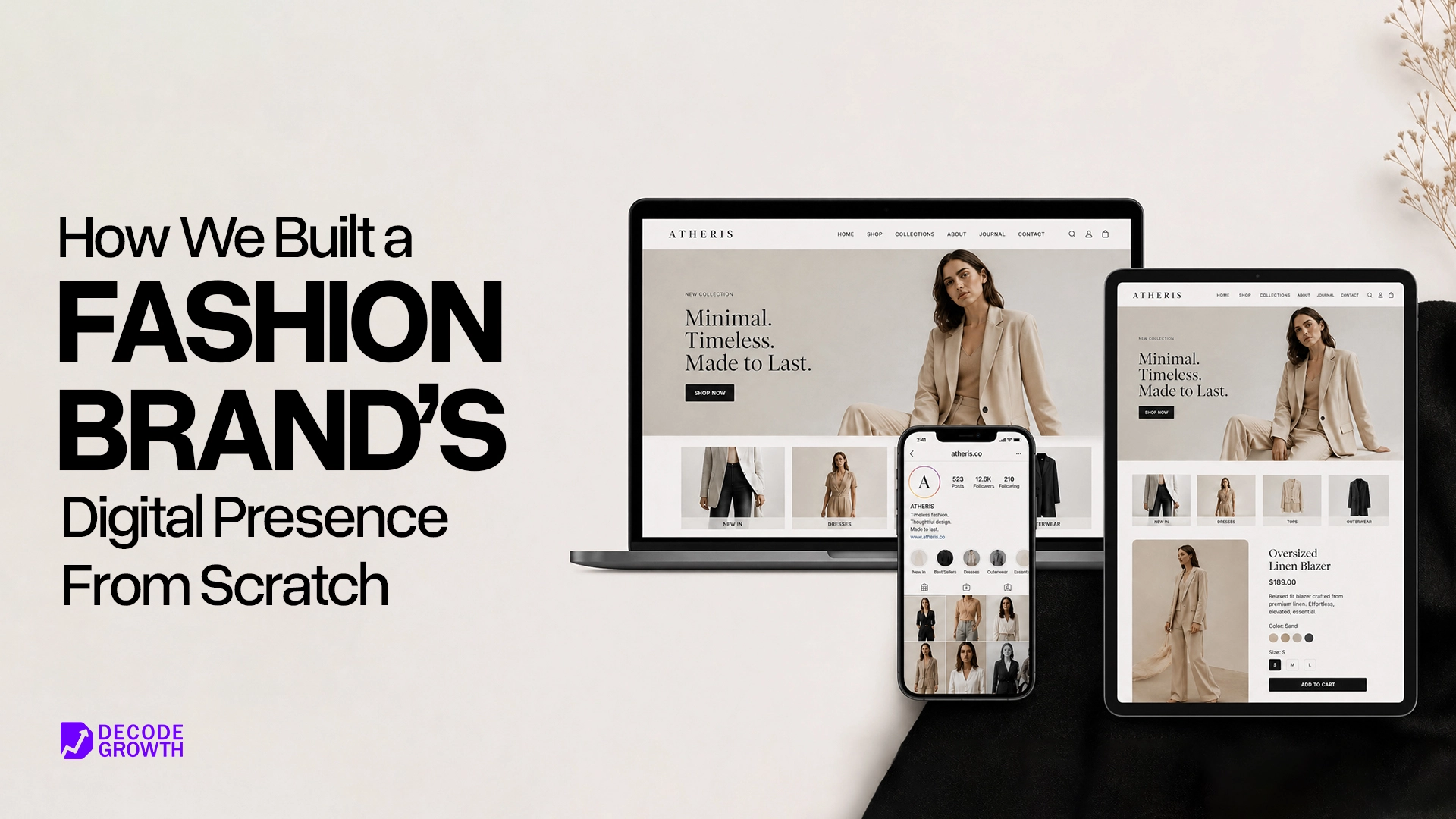
How We Built a Fashion Jewellery Brand’s Digital Presence From ScratchMost people think building a fashion brand starts with a great product idea. It does not. It starts with a clear answer to one question: who is this actually for, and why would she choose you over everyone else?
We built Zyouri, a fashion jewellery brand for the urban Indian woman, from the ground up inside Decode Growth. No existing products, no customer base, no follower count. Just a brief, a blank page, and a decision to build something that could genuinely compete in one of the most cluttered categories in Indian D2C.
In this blog, you’ll get to learn the process of building a fashion brand from scratch, including brand strategy, positioning, digital presence, and the decisions that look minor but determine everything later.
If you are building a fashion or accessories brand in India right now, or thinking about it, continue reading.
The First Problem: Most Fashion Brands Do Not Know Who They Are Saying No To
Everyone building a D2C fashion brand in India wants to be for “every woman.” That instinct makes sense financially. A wider audience means more potential buyers. But it is exactly why most brands become invisible.
The first real decision we made for Zyouri was not a product decision. It was a positioning decision, and it was built on knowing what Zyouri was not before we decided what it was.
Not a minimalist gold brand. GIVA owns that lane. Not a quirky fun-drops brand. A Little Extra is already there. Not an occasion-wear brand that only shows up around Diwali and wedding season. The Indian jewellery market is full of those.
The whitespace we found was a specific kind of woman and a specific problem she had: she is not one thing. She wants bold on a Saturday night, restrained on a Monday morning, fusion-intelligent for a relative’s mehendi, and experimental on a random Tuesday when she just feels like it. No brand was serving all four versions of the same woman without asking her to choose.
That became the core idea. Jewellery for women who know exactly who they are and feel like someone completely different tomorrow.
The lesson: before you decide what your fashion brand identity should look like, get ruthlessly specific about who you are not for. The competitors you are willing to concede space to are just as important as the gap you are stepping into.
Why Personas Need to Be Real People, Not Demographics
Every brand strategy template asks for a target audience. Most brands fill it in with a demographic: women, 22 to 34, urban, mid-income. That is not a persona. That is a census category.
Real personas are built from observation. From how people shop, wear, and talk about fashion.
For example:
- One person might switch identities between work and post-work life, shops frequently, and sees fashion through both experience and how it looks online.
- Another sees fashion as a reputation signal and prioritizes uniqueness and quality over discounts.
- Another buys on impulse, influenced by feeling and social validation, and drives word-of-mouth.
What they share is not demographics – it is attitude.
They shop based on who they are today, not the occasion. They trust their own taste.
The lesson: personas are only useful if they help you make decisions. If you cannot test content, products, or messaging against them, they are not real enough.
Brand Voice Is the Thing Most Indian Fashion Brands Get Wrong
There are two failure modes in brand voice for Indian D2C fashion brands.
The first is generic positivity. “Beautiful. Affordable. For every woman.” Forgettable within three seconds. It describes everything and no one.
The second is trying so hard to be edgy that the copy becomes alienating. Ironic to the point of cold. Clever in a way that excludes.
The test you need to do for every line of copy: Does a real person talk like this? Not a brand manager. Not a copywriter trying to sound like a brand. A woman who has taste and does not feel the need to explain it.
The lesson for fashion brand marketing strategy: voice is a guardrail, not a decoration. Write your list of what you will never say before you figure out what you will.
How We Approached the Digital Presence
Most fashion startup founders in India go straight from idea to Instagram account. They start posting before they know what they are saying or why. The aesthetic might be right, but the identity underneath it is thin. The first time someone asks, “What is this brand really about?” there is no clear answer.
Before we built Zyouri’s website or touched any content, we built the brand bible. Everything downstream of that document became dramatically easier: naming collections, writing product descriptions, briefing photographers, deciding which influencers to gift, and deciding which products not to launch.
The brand bible covered the mission, vision, values, positioning statement, the three personas in enough detail to drive real decisions, the four design codes with photography direction for each, the voice and tone guidelines with explicit “never use” lists, product architecture by phase, competitive positioning, and brand guardrails.
These decisions seem obvious when written down. But without writing them down, they get made inconsistently, and inconsistency is what makes brands feel cheap even when the product is not.
The Digital Presence Stack: What Zyouri’s Online Strategy Actually Looks Like
For a fashion jewellery brand launching in 2026, the digital marketing for fashion brands stack looks different from what it did three years ago. Here is how we structured.
Primary channel: D2C website on Shopify. Full brand experience. Best margins. Where the editorial photography lives. Where the brand world is experienced without the noise of a marketplace.
Secondary: Instagram. Not just a shop. The brand’s visual diary. Content organised around the pillars.
Influencer strategy: selective, not mass-seed. Micro and nano influencers between 5K and 50K followers. Aesthetic alignment over follower count. Gift one hero piece, not a haul. Ask for nothing. If the piece is right, she posts. If it needs to be negotiated, the piece was wrong.
The SEO strategy for fashion brands is a longer game but starts from day one: long-tail search terms around specific product types, mood-based discovery queries, comparison content for the category, and a blog that builds topical authority over time. Fashion SEO in India is underexplored. Most brands only invest in paid and social. Organic search is less competitive than it should be in this category.
What Packaging Strategy Taught Us About Brand Trust
The brand’s packaging brief was as detailed as its product brief. Matte black or warm ivory rigid box. Foil-stamped wordmark in copper. Black or ivory tissue inside. One insert card. One line of copy. No brand story paragraphs. No social media instructions. Brand stamp applied to the inside lid, not the outside. Discovered, not announced.
Every one of those decisions is a positioning decision. For a fashion brand operating at the budget price point, packaging is where the perceived value gap between you and a marketplace brand gets established in the first thirty seconds of the customer receiving the order.
What This Process Proves About Building a Brand
The exercise of building this brand taught us something concrete about what separates a brand from a product: a brand is a set of decisions made in advance, so that when you are moving fast, you are not making them up on the spot.
The brand bible, the persona work, the design codes, the voice guardrails, the sourcing philosophy, the packaging brief, the influencer criteria. All of these are pre-made decisions. They slow you down at the start and accelerate everything after.
If you are building a fashion brand in India and skipping straight to the Instagram account, you are not building a brand. You are building a product catalogue that looks like a brand until it does not.
The work that matters happens before anyone can see it.
At Decode Growth, we build brands before we build their digital presence. The brand bible, positioning, identity system, and go-to-market strategy were all built as part of our studio’s work, demonstrating what a fully realised D2C brand looks like across strategy and execution.
If you are building something and want to understand what the brand foundation should look like before you start spending on content and ads, let’s talk.
Frequently Asked Questions
Limited drops with a genuine no-restock policy. When customers know that a product goes and does not come back, the decision to buy is real. This requires structural commitment, not just copy saying “limited stock.” It also requires a content strategy around each drop: countdown, reveal, sell-out announcement. The drop model builds both urgency and the reason to keep following.
D2C website first for full brand experience and margin. Instagram second as the visual brand diary and discovery channel. Marketplaces like Myntra and Amazon third, and not before month three. Launching on a marketplace first trains customers to see you as a marketplace brand, which is a positioning you will spend months undoing. Build the brand before you distribute it.
Extremely. Voice is not decoration, it is positioning. The words a brand uses and refuses to use tell a customer exactly where the brand sits and who it is for. Most Indian fashion brands default to generic positivity that sounds like every other brand in their category. The brands with real recall have a voice distinct enough that you can identify them from a caption with the logo cropped out.
Start before the product. Define who the brand is specifically for, who it is not for, and what the gap is you are filling that competitors are not. Then build the positioning statement, persona profiles with enough detail to drive product and content decisions, and the voice guidelines with explicit rules on what the brand will never say. Everything visible, from the logo to the Instagram grid to the packaging, should flow from that foundation.