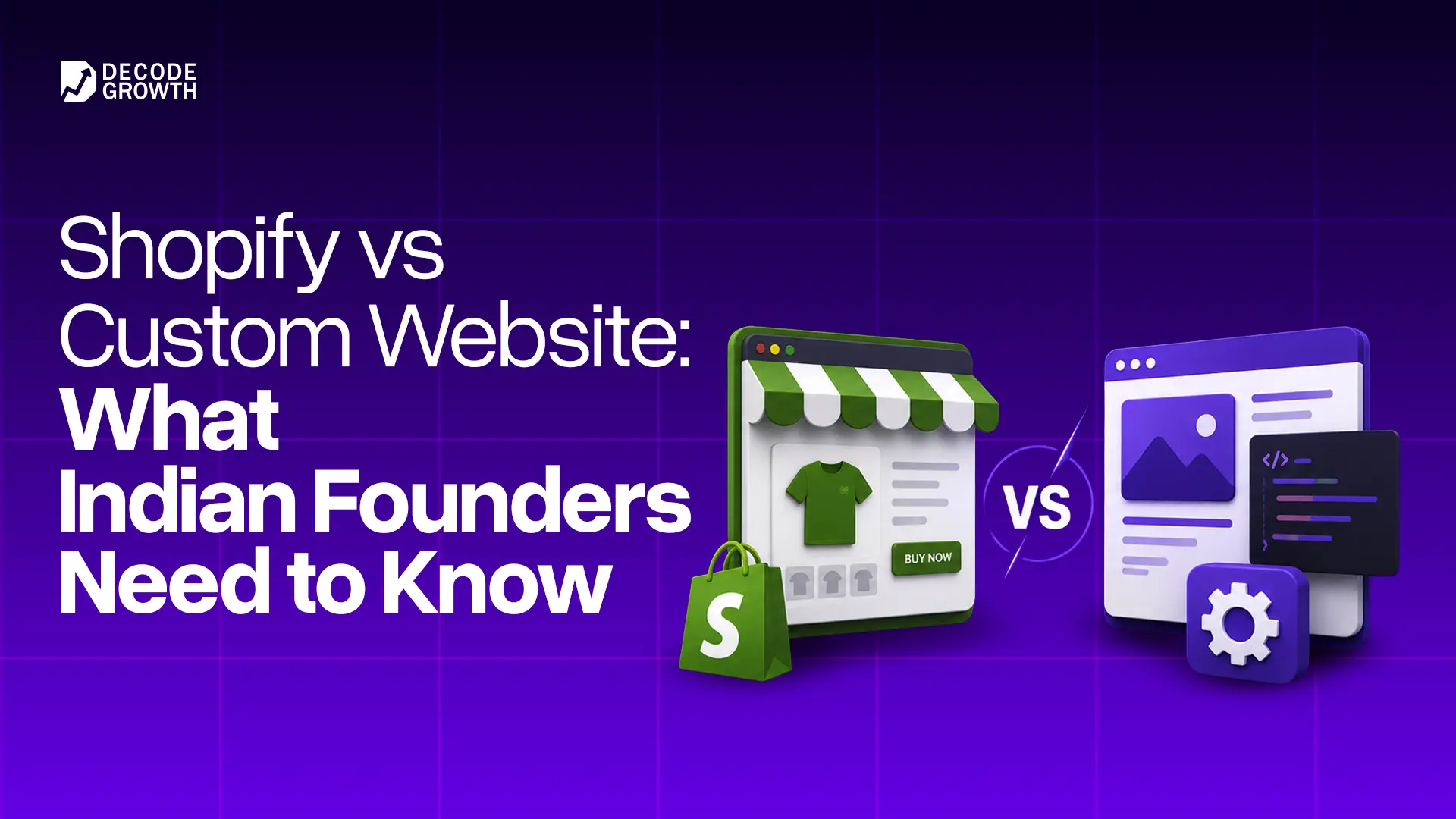
Let me be straight with you. If you are sitting there debating Shopify vs a custom website while your product is still unvalidated, stop. Start with Shopify. Ship fast. Learn from real customers. That advice alone will save you anywhere from 3 to 8 lakhs and probably 4 to 6 months of your life.
But if you already have traction and you are hitting walls on Shopify every single week? Then yes, a custom e-commerce website conversation makes complete sense.
I know that is not the nuanced 3,000-word answer you were maybe expecting. But that is the honest one. Everything below is just context to help you make the right call for your specific situation.
The Real Problem With How Founders Approach This Decision
Here is what I keep seeing. A founder in Bengaluru has a great product idea. She talks to an agency. The agency pitches a custom build. She spends 5 lakhs. Six months later, she is still waiting to launch while her competitor who set up a Shopify store in three weeks is already running Meta ads and getting their first 100 orders.
Or the opposite. A founder bootstraps a Shopify store, it takes off, and suddenly he is at 40 lakh a month trying to duct tape 14 different apps together because the platform cannot do what he needs anymore.
Both situations are painful. And both are avoidable if you understand what you are actually choosing between.
Shopify Is Not Just a Website Builder
People underestimate what Shopify actually does. When you sign up, you are not just getting a pretty storefront. You are getting hosting, SSL, security patches, payment gateway integrations, fraud analysis, inventory management, a checkout flow that is already conversion optimized, and a 8,000+ app marketplace. Shopify website development is genuinely fast because 90% of what a new e-commerce store needs is already there.
The platform handles Black Friday traffic spikes. It handles GST-friendly apps. It handles abandoned cart flows, discount codes, gift cards, multi-currency pricing. None of that requires a single line of custom code.
For a founder who needs to move fast, this is a massive advantage.
What a Custom Ecommerce Website Actually Costs You (Beyond Money)
A custom e-commerce website development project sounds exciting. Full control. Your vision. No limitations. And that is all true, eventually.
But before you get there, someone has to build your product catalog logic, your cart, your checkout, your payment integrations, your order management system, your admin dashboard, your return flow, your email triggers, and your mobile experience from scratch. That takes time. Usually 3 to 6 months for a decent build. Sometimes more.
And then after launch, every bug, every new feature, every server issue becomes your problem. Or more accurately, your developer’s problem, which means it becomes your invoice.
Custom e-commerce website development in India runs anywhere from Rs. 1.5 lakh for a bare-bones build to Rs. 10 to 20 lakh for something with real complexity. That is just the build. Maintenance, server costs, and ongoing development on top.
Shopify vs Custom Website Cost: Actual India Numbers
Let us talk real rupees because most comparisons online quote dollars and that does not help anyone building a business in India.
What Shopify Actually Costs Indian Merchants
Shopify pricing in India right now looks roughly like this:
Starter Plan at Rs. 399 per month is for selling through WhatsApp and Instagram links. No actual storefront. Good for testing demand before you even build anything.
Basic Plan at around Rs. 1,499 per month is where most new stores start. You get a full online store, unlimited products, basic analytics, and two staff accounts. This is your actual starting point for Shopify for startups.
The Shopify (Grow) Plan at around Rs. 5,599 per month makes sense once your store is doing Rs. 3 to 4 lakh a month. The lower transaction fees at this tier will usually offset the higher subscription cost.
Advanced Plan at around Rs. 22,680 per month is for high-volume stores. Most early-stage founders will never need this.
Now here is what the actual first-year spend looks like in practice. Basic plan subscription comes to around Rs. 18,000. A good paid theme runs Rs. 8,000 to Rs. 30,000 one-time. A few essential paid apps like reviews, upsells, and email marketing add Rs. 2,000 to Rs. 8,000 a month. And hiring someone to set up the store properly, design product pages, and configure everything costs Rs. 25,000 to Rs. 1.5 lakh depending on who you hire.
So realistic first-year total: Rs. 80,000 to Rs. 2.5 lakh. Not free, but dramatically cheaper than custom.
Custom Ecommerce Website Cost in India: What Agencies Will Not Tell You Upfront
The quote you get from most e-commerce website development companies in India covers the build. What it often does not cover is what happens after.
A basic custom build, say 50 to 100 products, simple checkout, Razorpay integration, admin panel: Rs. 1.5 to 3 lakh.
A mid-complexity build with custom logic, multi-vendor support, complex filters, loyalty points, or subscription billing: Rs. 4 to 8 lakh.
A full-scale platform built for serious volume: Rs. 10 lakh and above, sometimes well above.
After launch, plan for Rs. 15,000 to Rs. 50,000 per month for a developer retainer if you want bugs fixed promptly and features added regularly. Plus hosting costs of Rs. 3,000 to Rs. 15,000 a month depending on your infrastructure.
Run that math over two years and the total cost of ownership for a custom e-commerce website is almost always higher than Shopify, unless your revenue is genuinely at a scale where platform limitations are costing you real money.
The Hidden Cost Nobody Talks About: Time
This is the one that actually kills startups. Every week you spend building is a week you are not selling. You are not getting customer feedback. You are not learning what your market actually wants.
Shopify gets you live in two to four weeks if you work with a decent developer or agency. A custom build? Three to six months minimum, often longer.
In that time, your competitor launched, ran 400 ad experiments, figured out their best-selling SKU, and has repeat customers. Time is the most expensive thing a startup spends.
Shopify vs Custom E-commerce: Who Should Actually Go Which Route
Here is the honest framework. Not the version that makes agencies more money.
Start on Shopify If…
You are pre-traction. Your product has not sold yet or you have fewer than 50 to 100 orders. The best e-commerce platform for startups is whichever one gets you selling fastest. That is Shopify, period.
Your business model is standard. Physical products, a fixed catalog, normal checkout. Fashion, beauty, health, food, home. The vast majority of Indian D2C categories work perfectly well on Shopify without needing anything custom.
You do not have a full-time tech team. Running a custom e-commerce website without at least one dedicated developer is a recipe for 2 AM panics when the site goes down before a campaign launch.
You need to raise money. Investors want to see traction, not technology. A Shopify store doing Rs. 20 lakh a month is a far better pitch than a custom-built platform doing Rs. 2 lakh a month.
Consider a Custom E-commerce Website When…
You have validated your product and you are consistently doing Rs. 20 to 30 lakh per month or more. Now platform limitations are real, measurable, and hurting your numbers.
Your business model genuinely cannot work on Shopify. B2B with complex negotiated pricing, rental or subscription models with unusual billing logic, marketplace platforms with multiple sellers, auction-based selling. These are real cases where a custom build is the right answer from day one.
You have an in-house tech team. The economics of a custom build look completely different when you are not paying an agency retainer every month.
Shopify vs WordPress E-commerce: The Option People Forget
A lot of Indian founders ask about WooCommerce as a middle ground. And it is worth addressing honestly.
WooCommerce (WordPress with e-commerce plugins) gives you more flexibility than Shopify but without the development cost of a fully custom build. The catch is that you own the maintenance burden. Plugin updates break things. Hosting performance requires active management. Security is your responsibility.
If you already have a WordPress content site with real traffic and you want to add selling capability, WooCommerce makes sense. If you are starting fresh, Shopify is more reliable and faster to launch. The Shopify vs WordPress ecommerce debate usually ends with “it depends on your content strategy,” which means if content is your primary acquisition channel, WordPress. If paid media is your primary channel, Shopify.
What Indian Founders Actually Get Wrong (And How to Avoid It)
They Confuse “Custom” With “Better”
A custom build does not convert better by default. What converts well is trust, speed, good product photography, clear pricing, easy checkout, and fast shipping. You can have all of that on Shopify. A slow, buggy custom site with beautiful UI does not beat a fast Shopify store with clear copy and one-click checkout.
They Do Not Account for Post-Launch Reality
The build is 30% of the actual effort. The remaining 70% is running and improving the store after launch. New features. New integrations. Seasonal design updates. Fixing the thing that breaks every time you run a sale. On Shopify, most of that is manageable without a developer. On a custom site, every change needs one.
They Take Vendor Quotes at Face Value
An e-commerce website development company that quotes you Rs. 2 lakh for a custom build without asking about your business model, your catalog, your payment needs, or your growth plans is either giving you a low quote to win the project or underestimating the scope. Push them on what is included, what is not, what post-launch support costs, and get that in writing.
A Practical Roadmap to Make This Decision and Stop Second-Guessing
Step one: Write down every feature your store absolutely needs on launch day. Not eventually. Day one. Then honestly check whether Shopify’s Basic plan with two or three apps covers it. It will cover most of it.
Step two: If something on your list genuinely cannot be done on Shopify, research whether there is an app for it. Check the Shopify app store. Ask in founder communities. You will be surprised how often “this cannot be done on Shopify” turns out to mean “this requires a Rs. 3,000 per month app.”
Step three: If you are still hitting walls, get quotes from at least three e-commerce website development companies in India. Ask each one specifically what is included in post-launch support and what that costs separately. Compare the total 24-month cost, not just the build cost.
Step four: Set a revenue trigger for re-evaluation. Launch on Shopify, and decide in advance that when you hit X revenue consistently, you will revisit whether to migrate. Most Indian D2C founders find that trigger somewhere between Rs. 1 crore and Rs. 3 crore in annual revenue, when the business can actually support the team and investment a custom platform requires.
FAQs
Ask to see live stores they have built, not screenshots. Talk to one or two of their past clients directly. Check how their existing stores perform on mobile and in PageSpeed Insights. A good e-commerce website development company will ask about your business before talking about tech. If the first conversation is all about frameworks and UI and nothing about your customer journey, that is a red flag.
Yes, and it is more common than you think. Product data, orders, and customer information can all be migrated. Most brands that do this successfully have already built a strong business on Shopify first, which means they have the revenue to invest in the migration properly and a clear picture of what they actually need built.
Unless your business model is fundamentally incompatible with Shopify, start on Shopify. Startups need speed, not sophistication. The best e-commerce platform for startups is the one that gets you to your first 500 orders with the least capital spent on tech. Shopify does that better than any alternative right now.
Custom e-commerce website cost in India ranges from Rs. 1.5 lakh for a basic build to Rs. 15 to 20 lakh for something genuinely complex. Most mid-stage startups end up spending Rs. 4 to 8 lakh on the build alone. Add server costs, maintenance, and developer support and your two-year total is usually significantly higher than running a Shopify store at the same stage.
Honestly, yes. For small and early-stage businesses, Shopify is one of the smartest places to start. Shopify pricing in India starts at Rs. 1,499 per month for a full online store. You avoid expensive development costs, you launch faster, and you spend your budget on marketing instead of tech. Once your revenue grows, you can always re-evaluate.