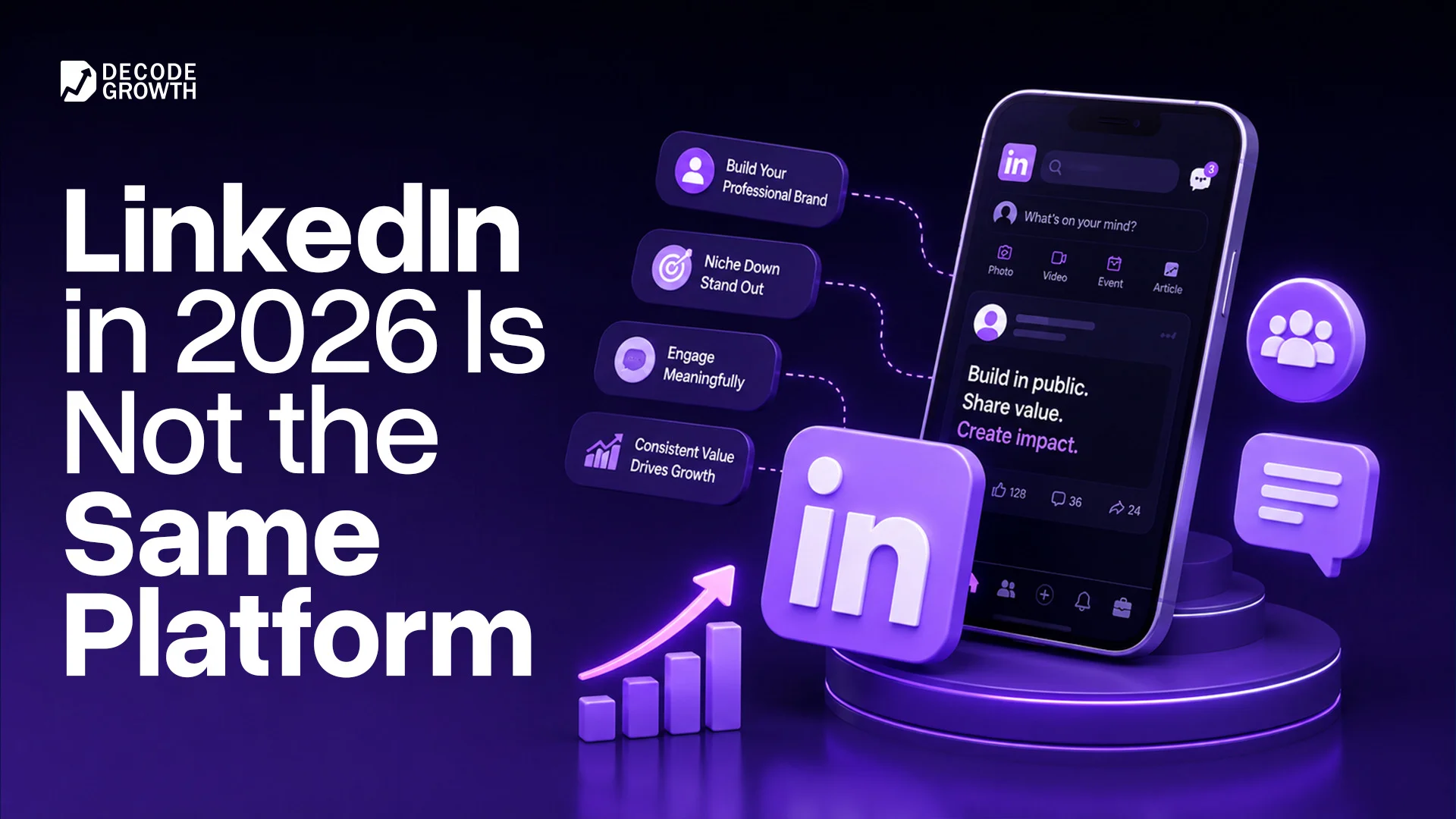
You posted on LinkedIn six months ago and it did well. You posted again last week with the same effort and the same quality of thinking, and it barely moved. That experience is confusing enough that most founders assume they have a content problem. Usually, they do not. The platform changed, and the strategy stayed the same.
LinkedIn between 2022 and 2026 went from a professional networking site with occasional viral posts to one of the most competitive content environments for B2B founders, SaaS operators, and service businesses in the world. Monthly active users crossed 1.1 billion. More founders are posting. More agencies are running “thought leadership” programmes on behalf of executives. More content is being produced every single day for the same pool of professional attention.
The result is a platform that looks similar on the surface but works completely differently underneath. The algorithm that used to reward polished professional updates now rewards something harder to fake: content that makes the right people stop scrolling, read slowly, and come back. Understanding what changed and why is the prerequisite for building anything real on LinkedIn in 2026.
The Three Algorithm Shifts Founders Are Not Accounting For
Dwell time replaced engagement as the primary signal. LinkedIn is now measuring how long someone actually spends on a post before moving on. A post with 200 reactions where the average read time was three seconds ranks lower than a post with 80 reactions where people stopped for 45 seconds and read every line. This is not a minor update. It changes the entire logic of what to write. Thin, punchy content that triggers a quick like and a scroll-past is actively deprioritised now. Dense, genuinely useful writing that earns real reading time is what the platform pushes forward.
Posts with external links get significantly less distribution. LinkedIn wants to keep people on LinkedIn. Posts that direct traffic off-platform, to websites, newsletters, or YouTube, are distributed to a much smaller audience than native content. Founders who built audiences by sharing blog links and newsletter issues in their posts saw sharp drops in reach as this weighting increased. The practical implication is that your best content needs to live natively on the platform, not somewhere else with LinkedIn as the pointing sign.
Creator Mode changed the distribution logic entirely. Profiles with Creator Mode enabled are treated by the algorithm as content sources rather than connection hubs. Their posts are distributed beyond their immediate first-degree network, reaching followers and topically relevant audiences outside their existing connections. Founders who have not enabled this are operating with a meaningfully smaller organic distribution ceiling than those who have, regardless of post quality.
What Founders Are Getting Wrong in 2026
Three patterns show up consistently among founders struggling with LinkedIn in 2026.
The first is posting updates instead of insights. “We closed our Series A” or “Excited to launch our new product” may get engagement, but they rarely build authority. The founders growing real audiences are sharing lessons, not announcements. An update tells people what happened. An insight explains what you learned and why it matters.
The second mistake is treating LinkedIn as a place to stay active instead of a distribution engine. Buyers, investors, and decision-makers now actively search LinkedIn for niche expertise. If your profile and content do not clearly communicate the specific problem you solve, you stay invisible to the people who matter most.
The third mistake is treating content like a one-way broadcast. Founders post, reply to a few comments, and move on. But in 2026, comment sections function almost like a second platform. Founders who leave thoughtful, valuable comments on other people’s posts consistently outperform those who only publish their own content.
The Content Strategy That Is Actually Working
There is no single formula that works for every founder. What works for a SaaS founder targeting enterprise procurement teams is different from what works for a bootstrapped service business going after SME clients. But certain principles show up consistently across the founders building genuine traction in 2026.
Specificity consistently outperforms breadth. The instinct is to write about leadership, entrepreneurship, or growth, topics broad enough to resonate with anyone. Content designed for everyone ends up connecting deeply with nobody. The posts building real audiences and generating real leads are specific in a way that feels almost uncomfortable to write. Not “how to retain talent” but “how we reduced engineering team churn from 40% to 11% in 18 months, including the three things we tried that failed.” Not “thoughts on fundraising” but “three things our Series A deck said that our Seed deck did not, and why each one changed the room.” Specific content attracts specific readers, and specific readers are the buyers, partners, and collaborators worth reaching.
Three formats are consistently earning dwell time right now.
The counterintuitive take: content that challenges a widely-held belief in your industry, backed by your own experience or data, earns longer reading time because it creates a moment of friction. The reader pauses because they disagree, or because they are genuinely questioning whether you are right. Either response extends the time they spend on your post. The format works when you state the conventional wisdom, directly challenge it with evidence from your own work, and explain what changed when you stopped believing it.
The detailed breakdown: longer posts, LinkedIn allows up to 3,000 characters, that walk through a specific process, decision, or lesson in genuine detail consistently outperform short punchy posts for profile visits and connection requests. The reason is authority. Anyone can claim to understand something. Demonstrating that understanding in a well-structured breakdown reveals mastery in a way that cannot be faked. These posts do not need mass reach. They need to reach the right 200 people who visit your profile, read your work, and decide they want to speak with you.
The transparent failure post: founders are conditioned to signal success. That is what makes genuine vulnerability, sharing a real failure, a strategic mistake, or a decision you would make differently, unusually powerful on LinkedIn. It stands out because it is rare. It builds trust faster than any amount of showcased achievement because it tells the reader that you are honest, self-aware, and willing to put your real experience ahead of your personal brand management.
Optimising the Profile for Discovery, Not Just Impression
Most founders treat the LinkedIn profile as a professional biography. In 2026, it needs to function like a landing page. When someone searches for an expert on a topic you cover, or visits your profile after reading one of your posts, the profile has one job: make the case, quickly and clearly, that this is the person worth knowing.
Your headline should describe what you do and for whom, not your job title. “Helping cloud software companies reduce churn in the first 90 days of onboarding” tells a potential buyer immediately whether they should keep reading. “Founder and CEO” tells them almost nothing. Your About section should read like an invitation, not a CV. What problem are you here to solve? What experience makes you credible? What should someone do if they want to explore working with you? Three hundred words of well-written copy here will do more for your pipeline than a dozen posts. The Featured section is prime real estate, and most founders either leave it empty or fill it with things that make sense internally but mean nothing to a first-time visitor. It should contain your single best post, your strongest case study, or a resource that delivers immediate value to the exact person you want to attract.
The Role of Direct Outreach
Most founders avoid this part because it feels uncomfortable. LinkedIn’s messaging, when used well, remains one of the highest-converting pipeline channels available to B2B founders. The difference between outreach that works and outreach that gets ignored is whether the message leads with value or with demand.
Every founder has received the connection request followed by a pitch two days later. Almost everyone ignores it. The approach that actually converts looks completely different. It starts with genuine engagement, a real comment on someone’s post that adds something specific to the conversation. It continues with a connection request without a note, because notes in 2026 read as sales setups before the relationship exists. When the timing is right, it moves to a message that either shares something genuinely useful to that specific person or opens a real conversation about a topic they have demonstrated interest in. Founders who are consistent about this report that it becomes their best-performing pipeline channel, because the people they eventually speak with arrive already familiar with how they think. The conversation starts with trust rather than a cold introduction.
The Compounding Effect Most Founders Quit Before They See
The LinkedIn content calendar that builds real results is not complicated. Three meaningful posts per week, each serving a different purpose: one that shares a real insight from something happening inside the business right now, one that challenges an industry assumption people rarely question, and one that breaks down a specific process, mistake, or lesson in genuine detail. That rhythm, sustained consistently over months, turns everyday work experience into a body of thinking that compounds over time.
The compounding effect becomes visible around the three to four month mark. The first month of consistent posting almost always feels like it is not working. Reach is modest, follower growth is slow, and the leads are not materialising yet. What is actually happening during that period is that the algorithm is calibrating: learning who finds your content valuable and beginning to distribute it more strategically. The founders who stop at week six because it is not working yet are quitting at the exact moment the platform is starting to move in their favour.
By month four or five, earlier posts start generating search traffic. New followers come in from shares. People start reaching out who found your content through someone else’s engagement. That is the moment LinkedIn starts working for you rather than the other way around. The founders who reach that point are not more talented writers. They are the ones who understood it was a long game and structured their rhythm accordingly.
Frequently Asked Questions
Enable Creator Mode, optimise your profile, post consistently, and leave thoughtful comments on relevant industry posts.
Yes. Niche expertise is often easier to grow because there is less competition and higher credibility when explained clearly.
Sales Navigator is valuable for outreach and lead generation. Standard Premium offers limited benefits for organic growth.
Personal profiles get significantly more organic reach than company pages. Use the founder profile as the primary growth channel.
Three high-quality posts per week is enough for most founders. Consistency matters more than daily posting.