Someone in Surat is driving to work. They hit a pothole, their dashcam beeps, and they say into their phone: “Google, Surat mein best dashcam repair shop kahan hai?” Three seconds later, Google reads out one answer. One shop gets a call. Every other shop with a website, a Facebook page, and a decent Google Business Profile gets nothing, because they were not the one answer that got read out loud.
Most businesses in India have built their entire digital presence around how people type. Short keywords, formal phrasing, desktop-first layouts. But the way people type and the way people talk are fundamentally different, and in India, that gap is growing every single day as hundreds of millions of new internet users come online with a smartphone in their hand and no patience for a keyboard.
India’s voice search usage has grown three times faster than text-based search, driven by regional language AI models and affordable smart device penetration. Regional language voice searches in India have grown over 270% year-on-year, with searches like “paas mein AC repair service” and “best budget smartphone Hindi mein” becoming commonplace. Hindi voice search queries alone grew 400% year-over-year according to 2025 Google India reports.
If your website is not built to show up in these conversations, you are not just missing a trend. You are missing the next version of your customer base.
Why Typing and Talking Produce Completely Different Searches
When someone types into Google, they think in shorthand. “Mumbai Delhi flight cheap.” When someone talks to Google, they think in full sentences. “What is the cheapest flight from Mumbai to Delhi this weekend?” The difference is not just length. It is structure, intent, and the kind of answer the search engine tries to surface.
Voice search almost always comes in the form of a complete question. It is longer, more specific, and more conversational than anything anyone would actually type. This matters enormously for SEO because Google processes these two query types differently and rewards different content for each.
71% of consumers say they prefer using voice search over typing when possible, and 70% of voice searches happen in natural conversational language. The person who asks “which moisturiser is best for oily skin in summer” is not the same user as the person who types “best moisturiser oily skin.” They are in the same market, but they are having a completely different conversation with the same search engine, and your content needs to show up in both.
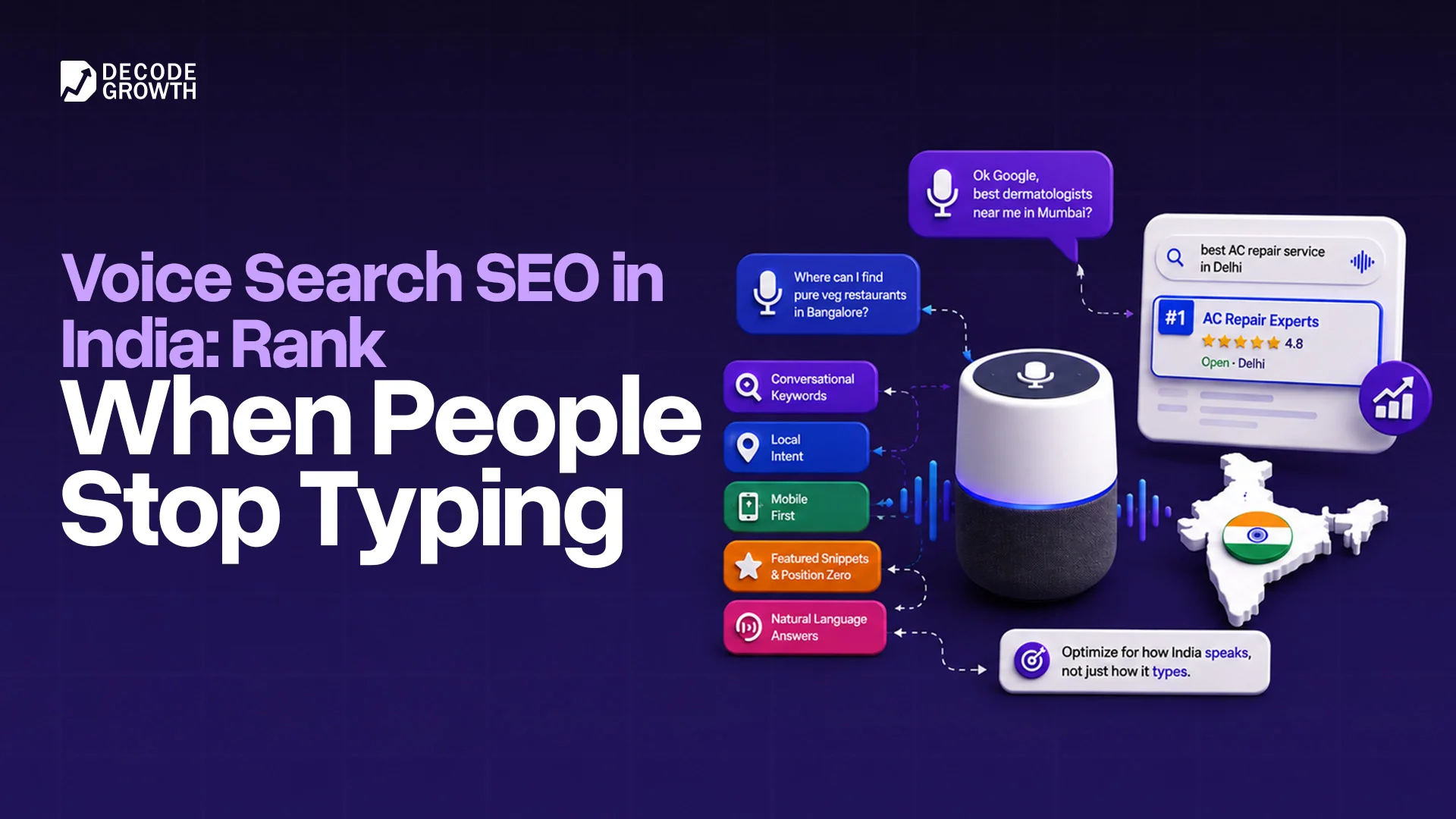
The deeper issue is that voice assistants do not show ten blue links. They read out one answer. Over two-thirds of voice search answers on Google Assistant come from featured snippets or top-three organic results. If you are not structured to win that position zero, you do not exist in a voice search result. Not page two, not below the fold. Simply not there.
The Hinglish Reality That Most SEO Guides Completely Miss
Here is something specific to India that no global voice search guide covers well: the dominant language of urban Indian voice search is neither pure Hindi nor pure English. It is Hinglish, and it is not going away.
Hinglish, the fluid mixing of Hindi and English, dominates urban Indian voice searches in a way that no keyword tool natively captures. Queries like “best chai café near me” or “budget hotel Mumbai mein” blend languages within a single sentence. This is not a mistake or approximation. It is a distinct linguistic register that millions of Indians use naturally.
This creates a real problem for standard keyword research. If you run a hotel in Mumbai and your SEO strategy is built entirely on English keywords, you are invisible to a massive segment of users who are searching for exactly what you offer, just in the language they actually think in. Tools like Google Keyword Planner and SEMrush do not capture Hinglish queries cleanly. The research has to happen at the ground level, which means talking to your actual customers and listening to how they describe their problems out loud.
79% of Indian internet users say they trust a brand more when it communicates in their local language. That trust gap closes the moment a brand speaks in the same mixed, natural register that its customers use every day. The brands building FAQ sections, product descriptions, and landing pages in actual conversational Hinglish are capturing ground that their competitors have not even realised exists.
Beyond Hinglish, regional language voice search is where the real scale lives. Hindi has become the second most-used language on Google Assistant globally, trailing only English. In rural India, over 40% of users rely exclusively on voice to navigate the web, book services, and find information. A Rajasthani dry cleaner, a Chennai auto parts shop, a Pune bakery, each of these businesses has a local voice search audience actively looking for them. Most of them have no idea.
The Four Things Voice Search Actually Rewards
Voice search ranking is not complicated. It comes down to four factors, and most Indian businesses are struggling on all four at the same time.
Structured content that answers questions directly. Google’s voice assistant reads out featured snippets. If your content cannot deliver a clean, direct answer to a specific question in under 50 words, it will not be selected. The content format that wins is a short paragraph or a well-built FAQ section that is phrased the way a person would actually ask the question out loud. Not “Benefits of moisturiser for oily skin.” But “Which moisturiser should I use if I have oily skin?”
Page speed on mid-range Android devices. Pages that rank for voice search load 52% faster than average pages. In India, the average user is on a mid-tier Android device with variable 4G connectivity, not a high-end phone on a 5G connection. If your website takes more than three seconds to load on mobile, voice search users leave before they ever see your answer. Google’s mobile-first indexing means this directly impacts your organic rankings across the board, not just voice.
A complete and accurate Google Business Profile. 76% of voice searches have local intent, the classic “near me” type queries. When someone asks Google “shoe repair shop near me” or “Gujarati restaurant Ahmedabad mein,” the answer almost always comes from a Google Business Profile, not a website. If your profile is incomplete, has outdated hours, or has inconsistent contact information across platforms, you are invisible at exactly the moment a customer is ready to act.
Schema markup that tells Google what your content is. A schema is structured data you add to your website that helps search engines understand the purpose of each page. The FAQ schema, Local Business schema, Product schema, and Review schema all increase the probability that your content gets surfaced as a voice answer. Only 10% of sites currently optimise for voice according to SEMrush data from 2025. That is a gap, and for any Indian business willing to implement the schema properly, it is a first-mover advantage that is genuinely available right now.
How to Actually Build Voice Search Content That Ranks
The starting point is not a keyword tool. The starting point is your customer.
Write down the ten most common questions your customers ask before buying from you. Not the polished marketing version of those questions. The actual words they use when they call you, walk into your shop, or message you on WhatsApp. Those questions, phrased in the natural language of the person asking them, are your voice search content strategy.
For an Indian audience that spans both urban English speakers and regional language users, your FAQ architecture needs to reflect both registers. “What is your return policy” is a typed query. “How do I return something I don’t like” is a voice query in English. “Agar mujhe product pasand nahi aaya toh main kya karun” is a voice query in Hindi. If your audience spans both, your FAQ page should speak both languages, not as a translation exercise but as two genuine versions of the same answer written for two different readers.
Once you have the questions, structure your answers for voice readability. Keep each answer between 40 and 60 words. Put the direct answer in the first sentence, not buried after two sentences of context. Use simple sentence structure. Voice assistants do not read bullet points, they read prose, so write your answers as complete, flowing sentences that sound natural when read aloud.
Add FAQ schema to every page that has FAQ content. This is a straightforward technical implementation in JSON-LD format and it significantly increases the likelihood that Google selects your content as a featured snippet. If you are on WordPress, plugins like Rank Math and Yoast make this implementation simple enough that any content writer can do it without touching code.
Regional Language SEO Is Not the Same as Translation
This is the most expensive mistake brands make when they try to enter regional voice search. They translate their English content into Hindi or Tamil and consider the problem solved. It is not.
Localisation means writing content for the way people in that region actually think and speak. A user in Chennai asking “naan enga best restaurant?” is not asking a generic question with Tamil words. They are asking within a cultural and geographic context that a straight translation of your English content will completely miss. The answer they want is specific, local, and in a voice that sounds like it understands their world.
Start with one regional language rather than trying to cover multiple simultaneously. Pick the language that represents your largest non-English audience segment and invest in creating genuinely localised content for that language first. Once that content is indexed and bringing in traffic, expand. Shallow presence across five regional languages produces worse results than deep, well-written content in one. Depth wins.
Google’s Bhashini integration enables real-time translation, so content in one Indian language can surface for queries in another. But native optimization still outperforms machine translation. Write it like a person wrote it, because in voice search, that is exactly who you are competing against: the few businesses in your category that have already done this work.
The Technical Work That Cannot Be Skipped
Content strategy without technical infrastructure is a waste. Here is what voice search readiness looks like from a technical standpoint.
Run your website through Google PageSpeed Insights and aim for a mobile score above 80. Compress images, enable lazy loading, and configure browser caching. If your site is on Shopify, the theme you chose matters more than you think. Many popular Shopify themes are bloated with unused JavaScript that quietly kills mobile load time. Check this before you do anything else.
Verify your Google Business Profile and fill it to 100% completion. This means adding accurate business hours, listing your services in the specific language your customers use to search for them, uploading photos, and responding to reviews. Practo uses voice SEO to answer local health queries like “Bengaluru mein doctor dikhaaye,” and SBI allows customers to check balances using voice commands in local languages. These are large brands with dedicated teams, but the underlying principle, meeting the user in the language and format they prefer, applies equally to a local clinic or a neighbourhood restaurant.
Implement HTTPS if you have not already. Google prioritises secure sites in voice results. This is not a voice search-specific requirement, but it is a prerequisite for being taken seriously in any search context.
Add Local Business schema to your location pages, FAQ schema to your FAQ sections, and Product schema to your product pages. Use Google’s Rich Results Test to verify that your schema is implemented correctly before publishing.
Where Most Brands Will Be in 12 Months If They Do Nothing
The voice search market value is projected to reach 45 billion dollars by 2030, with voice-enabled advertising growing over 25% annually through 2028. India specifically is growing faster than any other market. The brands starting to build voice-optimised content today are establishing a compounding advantage that will be genuinely difficult to close later.
Voice search content compounds the way good SEO always has. A well-structured FAQ page that wins a featured snippet for a high-intent question keeps bringing in voice-referred traffic every single month without additional spend. That is fundamentally different from paid search, which stops the moment you stop spending.
The businesses that wait will find themselves trying to compete in a landscape that is significantly more crowded, bidding against brands that have six months of indexed, structured, regionally localised content already working for them. The window for first-mover advantage in Indian regional voice search is not permanent. It is open now.
Where to Start If You Have Not Started Yet
Do not try to fix everything simultaneously. Sequence matters.
Start with your Google Business Profile. If it is incomplete or unverified, that is your most urgent fix and the one that will show results the fastest. Get it to full completion, add your services in the language your customers use, and start adding posts that answer the questions your customers are most likely to ask aloud.
Then go through your existing content and find pages that are already ranking between positions four and ten for question-based queries. These are your best candidates for restructuring into direct-answer format with FAQ schema. You often do not need to create new content to win featured snippets. You need to restructure what you already have.
Then build your regional language content strategy, starting with Hindi if North India is your primary market. Write it as a native speaker would write it, conversational, specific, and regional. Do not translate. Write fresh.
Fix the technical foundation in parallel: speed, schema, structured data, mobile usability. Every piece of voice-optimised content you create is working at a fraction of its potential if the technical foundation underneath it is broken.
Frequently Asked Questions
Voice search is primarily local and consumer-oriented today, but B2B voice usage is growing, particularly for research-phase queries. A procurement manager asking “best ERP software for manufacturing companies in India” is a voice query. B2B brands that build thorough, question-based content around industry-specific problems and deliver answers in clear, direct language can capture voice traffic at the research stage of the buying cycle, even when conversion happens much later through a traditional sales process.
Google Search Console does not currently offer a direct voice search filter. But you can infer voice traffic by looking for longer query strings, a high proportion of question words like who, what, where, how, why, and when, and an increase in location-based queries in your organic traffic data. Tracking these patterns month over month as you implement voice SEO changes gives you a reliable picture of whether your visibility is improving.
Find a question your customers are actively searching for where the current featured snippet answer is weak, generic, or incomplete. Write a better answer in 40 to 60 words: specific, direct, and structured clearly. Add FAQ schema to the page. Build two or three supporting pieces of content around the same topic to establish authority. That sequence, repeated consistently, is how featured snippets get won.
Start with the regional language that represents your single largest non-English audience segment. Build genuinely localised content for that language first, meaning write it fresh, not translated. Once that is indexed and bringing in regional voice traffic, expand to a second language. Trying to cover multiple languages at once with limited resources produces weak output across all of them.
Not entirely. The biggest shift is in writing style: more conversational, more direct, and built around specific questions rather than broad topics. Most of the technical work, schema, page speed, mobile usability, benefits your regular search rankings as well. Think of voice optimisation as a layer on top of solid SEO practice, not a separate discipline.