There’s a moment every digital marketer remembers, the first time they realized that the scroll and the shopping cart had merged into one seamless motion. That moment is no longer a memory. It’s the new normal.
In 2026, social commerce is not a trend worth “exploring.” It is a fundamental rewriting of how products get discovered, evaluated, and bought. Brands that still think of Instagram as a place to build awareness and then send people “somewhere else” to buy are operating on borrowed time. The platforms have already moved the checkout counter directly into the feed.
This guide breaks down everything you need to know, from what social commerce actually means today, to how your digital marketing strategy needs to evolve to win in this environment.
What Is Social Commerce?
Let’s start by separating social commerce from two things it is constantly confused with.
Social media marketing is about building a presence, growing a community, and driving awareness. The transaction happens somewhere else, usually your website.
Social media ecommerce traditionally referred to using ads on platforms to drive paid traffic to your online store. Again, the purchase happened off-platform.
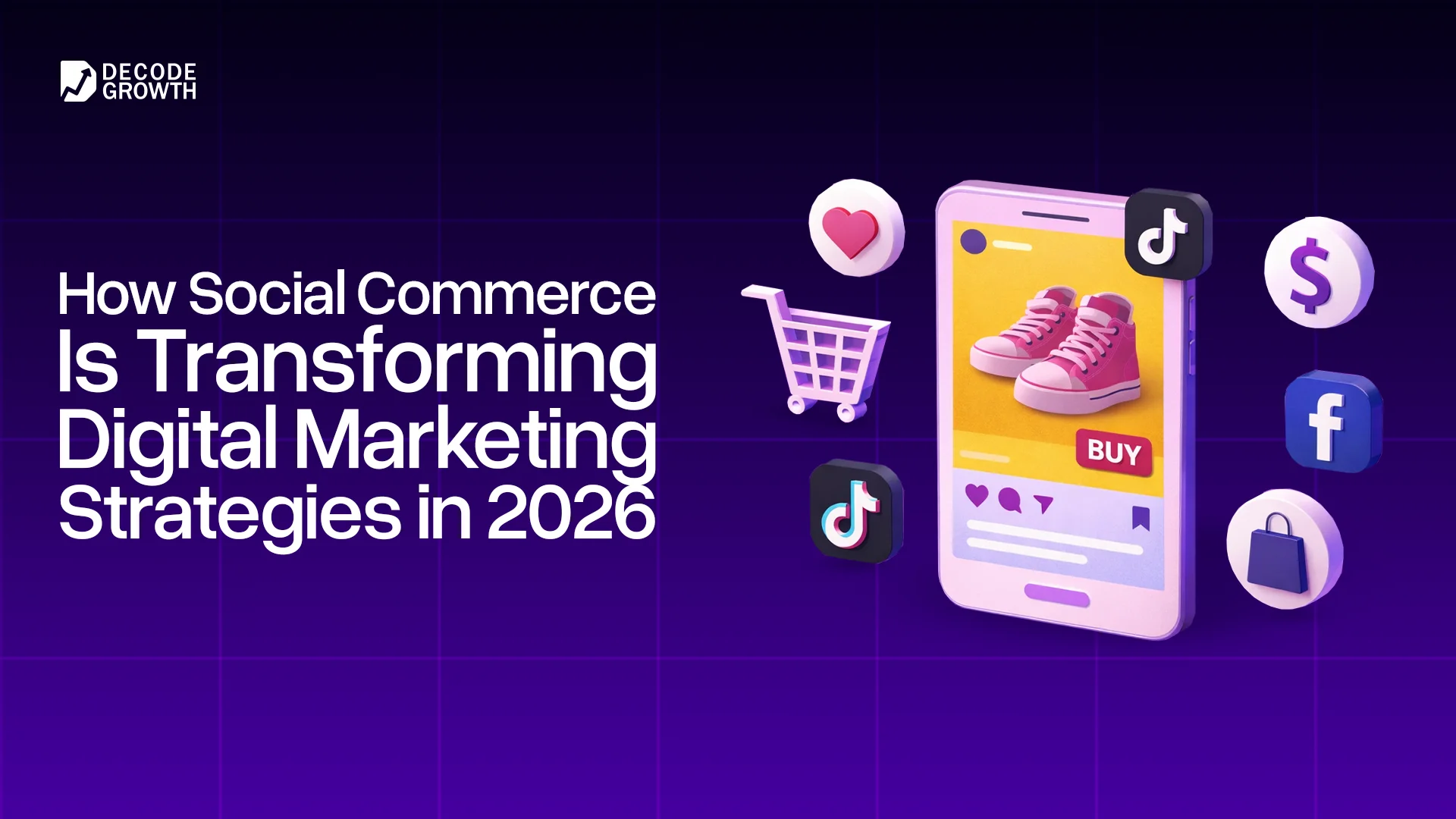
Social commerce is different. It means the entire journey, discovery, consideration, decision, payment – happens inside the social platform itself. A user watches a Reel, taps the product tag, sees the price, and completes the order without opening a single new browser tab.
But here’s what most brands still miss: social commerce in 2026 is not just about in-app purchases. It is about collapsing the traditional marketing funnel into a single, frictionless experience. Whether the checkout happens in-app or redirects to a landing page, the key shift is that social media is now a full sales funnel, not just the top of one.
Why Social Commerce Is Rewriting Digital Marketing Strategy
Traditional digital marketing strategy followed a somewhat predictable path. You attracted strangers through content and SEO, warmed them up with ads and email, and eventually converted them on a landing page or product page. The funnel was long, measurable, and controllable.
Social commerce compresses that entire journey. Here’s what it’s actually changing:
1. The Discovery Phase Is Now the Purchase Phase
When a user stumbles on your TikTok video and can tap to buy in under 10 seconds, the distinction between awareness and conversion collapses. Your content is no longer the top of the funnel, it is the funnel.
This fundamentally changes how you should think about content creation. Every piece of content now needs to be evaluated not just on engagement metrics, but on its potential to convert. Hook, showcase, close, all in under 60 seconds.
2. Trust Is Built Differently Now
Banner ads and polished brand videos used to be the primary trust signals online. Today, modern consumers trust creators and influencers more than polished brand advertisements, which is why creator-led commerce has become the dominant format across every major platform.
This isn’t a reason to abandon brand consistency. It’s a reason to invest in authentic partnerships where real people, with real audiences, demonstrate your product in real contexts. User-generated content (UGC) has become the most cost-efficient form of social proof available to brands in 2026.
3. The Funnel Is Now Platform-Specific
A digital marketing strategy in 2026 can’t be one-size-fits-all across platforms. Each platform has its own social commerce ecosystem, its own audience behavior, and its own native checkout experience.
- Instagram Shopping excels at aspirational lifestyle products, where visual storytelling drives desire.
- Facebook Shops remain powerful for older demographics and community-driven purchases.
- Pinterest Product Pins convert exceptionally well for home decor, weddings, and DIY – because intent on Pinterest is already high before a user even sees your pin.
- YouTube Shopping is gaining ground for considered purchases, where consumers want longer demonstrations before committing.
A truly effective social media marketing strategy doesn’t just show up on all platforms, it understands which platform owns which stage of the purchase decision for each product category.
The 2026 Social Commerce Playbook: What’s Actually Working
Theory is useful. Tactics are better. Here’s what high-performing brands are actually doing right now.
Build for Shoppable Video First
Video is the undisputed champion of social commerce in 2026. But not all video is equal. The format that converts is what some call “enter-tainment” – content that simultaneously entertains and educates, making the product feel like a natural part of the narrative rather than an interruption.
The winning formula looks like this: open with a problem the viewer recognizes, demonstrate the product as the solution in an authentic context, and close with a clear, low-friction path to purchase. No corporate voiceover. No stock footage. Real situations, real results.
If you haven’t built your content marketing strategy around shoppable video yet, you’re already behind the curve.
Invest in Micro-Influencer Partnerships
The era of throwing budgets at celebrity influencers with millions of followers is giving way to something smarter. Micro-influencers, typically creators with between 10,000 and 100,000 followers, consistently outperform on engagement rates and purchase intent.
Why? Because their audiences trust them. When a micro-influencer in the skincare space recommends a product, their followers don’t experience it as advertising. They experience it as a recommendation from someone they respect.
For brands, this translates to better conversion rates at lower cost per acquisition. The math works. The strategy works. What it requires is the operational capacity to manage multiple creator relationships simultaneously, which is where a strong social media management approach becomes essential.
Use Live Shopping to Recreate the Human Connection
Live commerce is quietly becoming one of the highest-converting formats in the social commerce playbook. It recreates something that pure ecommerce stripped away, the feeling of being in a room with a knowledgeable, enthusiastic person who can answer your questions in real time.
On Instagram Live Shopping, and YouTube Live, brands that commit to regular live selling events see measurable lifts in both conversion rates and average order values. The key isn’t production quality, it’s energy, authenticity, and responsiveness to real-time audience questions.
Optimize the Handoff
Not every brand will sell directly through in-app checkout and for many, that’s completely fine. What matters is that the handoff from social platform to landing page is seamless.
If someone clicks a product tag on Instagram and lands on a slow, cluttered, mobile-unfriendly page, you’ve lost them. The social platform did its job. The website failed.
This is where performance marketing and website optimization become inseparable from your social commerce strategy. Fast load times, mobile-first design, single-step checkout, and trust signals above the fold are non-negotiables.
Common Social Commerce Mistakes (And How to Avoid Them)
Even brands with significant resources get this wrong. Here are the mistakes worth learning from before you make them:
Treating social commerce as a separate channel. Social commerce is not a department. It’s a mindset that should run through your content, your paid media, your influencer program, and your website experience. Siloing it produces mediocre results.
Ignoring mobile-first design. Social commerce is overwhelmingly a mobile experience. If your product pages haven’t been designed and tested primarily for mobile users, you’re losing sales at the finish line.
Over-producing content. Ironically, the most polished content often performs worst in social commerce contexts. Authenticity beats production value consistently. A 30-second video shot on a phone by a real customer frequently outperforms a 100k product shoot.
Not capturing data from in-app sales. When you sell through a platform’s native checkout, you often have limited access to customer data. Build strategies to bring those customers into your own ecosystem – post-purchase follow-up, loyalty programs, and off-platform communication become critical.
Setting and forgetting. Social commerce requires constant iteration. What performs well this month may need a complete rethink next month. Brands that commit to testing, learning, and adjusting build durable advantages. Those that find one format that works and repeat it indefinitely find themselves overtaken.
Final Thoughts
Social commerce is not a feature you bolt onto your existing strategy. It is a fundamental reorientation of how you think about the relationship between content, community, and commerce.
The brands and businesses that will dominate in 2026 and beyond are the ones who understand that every piece of content is a potential entry point into a purchase, that trust is built through authenticity rather than polish, and that the line between marketing and selling has permanently blurred.
The question isn’t whether to invest in social commerce. The question is whether you’re building the infrastructure, the content, the partnerships, the platform presence, the measurement systems,to make that investment pay off.
If you’re ready to build a social commerce strategy that actually converts, talk to the team at Decode Growth. We’ll help you figure out exactly where to start and how to scale.
Frequently Asked Questions About Social Commerce
Q.1 What is social commerce in simple terms?
Ans Social commerce is shopping that happens directly within social media platforms. Instead of clicking an ad and going to a separate website, users can discover, evaluate, and purchase products without leaving the app they’re already using.
Q.2 How is social commerce different from regular ecommerce?
Ans Regular ecommerce requires a user to visit a dedicated online store. Social commerce embeds the shopping experience within social media platforms, reducing friction and meeting customers where they already spend their time.
Q.3 What is social media ecommerce?
Ans Social media ecommerce refers to the broader practice of using social platforms to drive sales, whether through in-app purchases or by directing traffic to an external online store. Social commerce is a subset of this, specifically focused on in-platform transactions.
Q.4 Which platforms are best for social commerce in 2026?
Ans. Instagram Shopping, Facebook Shops, and Pinterest are the primary platforms. The best choice depends on your product category and target audience demographic.
Q.5 What is a digital marketing strategy for social commerce?
Ans A digital marketing strategy for social commerce involves identifying the right platforms for your audience, creating shoppable content, building creator partnerships, optimizing the purchase experience, and connecting social sales to your broader customer retention and remarketing programs.
Q.6 How much does it cost to get started with social commerce?
Ans The barrier to entry is surprisingly low, setting up Instagram Shopping is free. The real investment is in content creation, creator partnerships, and the operational infrastructure to manage the channel effectively.