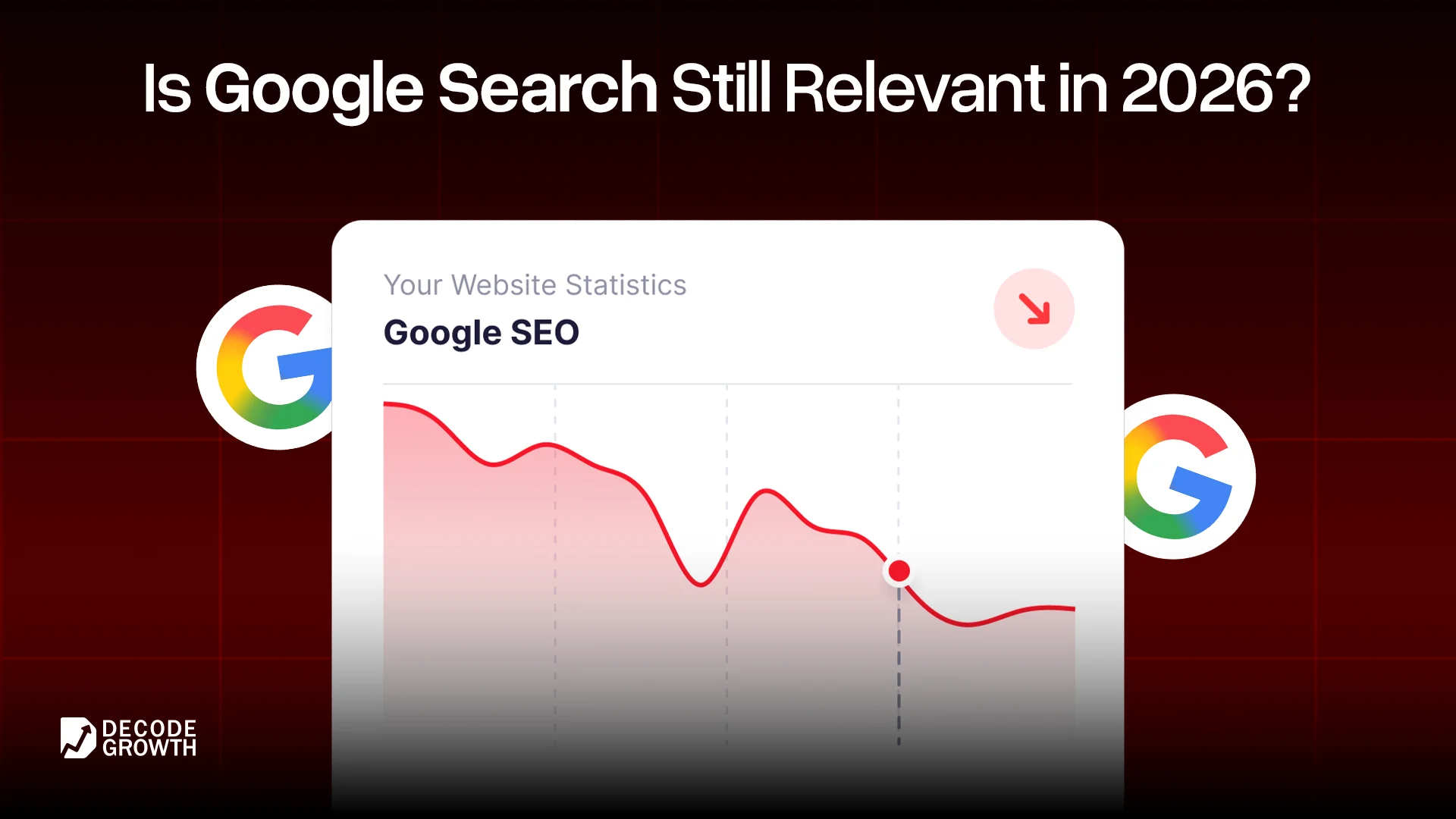
A website sitting at position two for its best keyword. Impressions climbing. Rankings are completely stable. And yet, traffic is down 38% in four months. No penalty. No technical issue. No algorithm punishment.
Just Google, quietly rearranging furniture in a house that someone else built.
This isn’t a rare edge case anymore. It’s the new standard experience for thousands of websites across every industry. Rankings and visibility used to be the same thing. In 2026, they’re not. And that gap between where a page ranks and whether anyone actually arrives, is the most important story in digital marketing right now.
So here’s the real question worth asking: is Google Search still the force it used to be? And if the rules have changed this dramatically, what does SEO even mean anymore?
The answer is more nuanced than most hot takes suggest, and considerably more useful than “SEO is dead.”
Google Search Is Still Relevant. But “Relevant” Looks Different Now.
Let’s get something straight before we go any further. Google Search is not dead. Anyone telling you to abandon SEO entirely is selling you something, probably a replacement service they happen to offer.
Google still handles somewhere between 8 and 12 billion searches every single day. It remains the starting point for the vast majority of purchase decisions, research queries, and navigational intent online. Its market share has dipped below, 90% for the first time in a decade, but that still leaves it as the most dominant discovery platform on the internet by a wide margin.
What has changed is what happens after someone types a query.
For a long time, the game was simple. Google showed ten blue links. You tried to be one of them, ideally near the top. A percentage of searchers clicked. Those clicks became traffic. Traffic became leads. Leads became revenue.
That model still exists. It’s just been heavily modified by something most marketers are still trying to fully wrap their heads around: Google is no longer primarily in the business of sending you traffic. It’s in the business of answering questions. And it’s getting very, very good at answering them without asking users to go anywhere else.
What AI Overviews Actually Are (And What They Mean for Your Content)
In 2024, Google rolled out what it now calls AI Overviews – the summaries that appear at the very top of many search results pages, generated by its Gemini AI. Before a user sees a single organic link, they often get a paragraph or two that directly answers their question, synthesised from multiple sources across the web.
Pages that consistently appear in AI Overviews typically use question-based headings, provide concise answers at the beginning of each section, and follow a logical, scannable format, because this structure helps AI systems extract meaning efficiently and with high confidence.
What this means practically: the way you structure content now determines whether you get cited in the answer or ignored completely.
The old approach was: write an article, stuff it with keywords, build some backlinks, climb the rankings. That approach still sort of works for traditional organic results. But AI Overviews pull from a different logic. They’re looking for clarity, directness, expertise, and structure. They want content that can be summarised without losing its meaning.
There’s also something quietly important happening with which content gets cited. According to BrightEdge, 89% of citations in AI Overviews come from beyond the top-10 organic results. A page ranking at position 14 that is well-structured and authoritative can appear in an AI Overview while the pages ranking above it get nothing.
That breaks one of the fundamental assumptions SEO has operated on for twenty years, that ranking position and visibility are the same thing. They are no longer the same thing.
The Rise of AI Search
Here’s where it gets more complicated. Google isn’t the only search experience your potential customers are using anymore.
Experts describe the split this way: “Google handles the transactions, and ChatGPT handles the thought. Google is the place you go when you already know what you want. ChatGPT is the place you go when you don’t.”
That’s a fairly neat way of capturing something real. When someone wants to buy running shoes, they still mostly go to Google. When someone is trying to understand whether they should change their marketing strategy, they’re increasingly asking for an AI tool first.
AI platforms generated 1.13 billion referral visits in June 2025, representing a 357% increase from June 2024.
And the quality of that traffic is striking. AI search traffic converts at 14.2% compared to Google’s 2.8% – meaning visitors who arrive via AI search are far more likely to take action than those arriving from traditional organic search. Lower volume, sharper intent.
The person who asks ChatGPT “best digital marketing agency for ecommerce brands in India” and sees your name mentioned is a very different prospect from someone who stumbled onto you from page two of Google.
SEO in 2026 isn’t “Google-only” anymore, it’s search ecosystem optimization. Visibility now has to be managed across Google, ChatGPT, Perplexity, Gemini, and whatever AI tool comes next.
What Search Engine Optimisation Actually Means in 2026
The phrase “SEO” hasn’t been updated to reflect what the job actually involves now. Let’s break down what it means in practice.
Keywords Still Matter – Just Not the Way They Used To
Keywords haven’t become irrelevant. But keyword density, exact-match phrases, and the old trick of repeating a search term seventeen times in a 1,200-word article? That era is definitively over.
Keywords remain relevant, but AI prioritizes contextual relevance, semantic depth, and conversational intent over exact-match optimization.
What this means: a page can rank well for a keyword it never explicitly uses, as long as it comprehensively addresses the topic behind that keyword. The shift is from keyword targeting to topic mastery. Write the most genuinely useful thing on the internet about your subject. Cover the related questions. Address the doubts. Go deeper than your competitors. That’s what ranks now — and more importantly, that’s what gets cited by AI systems.
E-E-A-T Has Become the Actual Foundation
Google’s quality framework – Experience, Expertise, Authoritativeness, Trustworthiness, was introduced years ago, but it’s become the primary filter in 2026.
Websites that publish generic or AI-generated content without expertise are seeing reduced visibility. When businesses demonstrate expertise and industry experience, they align with Google’s E-E-A-T framework.
Practically, this means: who wrote this content matters. Are they named? Do they have credentials? Does the site have author biographies? Is the content based on real experience or just assembled from other sources? Google’s systems are getting increasingly capable of distinguishing between content written by someone who actually knows their subject and content that’s just competently formatted.
For Decode Growth clients, this is one of the most actionable things we work on, establishing genuine topical authority through expert-led content, not just a content calendar.
Answer Engine Optimisation (AEO) Is Now a Real Discipline
There’s a phrase you’ll hear more and more: AEO, answer engine optimization. It refers to structuring content specifically to be selected as a direct answer, in Google’s AI Overview, a featured snippet, a voice response, or an AI chatbot reply.
The technical requirements for AEO are specific. Write a concise, direct answer to the main question at the top of each article, ideally within the first 50-70 words. Use question-based headings that match how people phrase queries. Include structured data (schema markup) that helps machines understand your page. Keep answers factually tight and current. Build genuine off-site authority through backlinks, brand mentions, and consistent industry presence.
This evolution marks the rise of Answer Engine Optimisation (AEO) – the new bridge between traditional SEO and AI-driven discovery.
If your SEO strategy doesn’t include AEO as a distinct component, you’re optimising for a version of search that no longer fully exists.
Voice Search Optimisation Is No Longer Optional
Voice search and mobile queries are driving increasingly high zero-click rates, because when someone asks a voice assistant a question, a single answer is read aloud. There is no list of ten links.
Voice queries are structured differently from typed ones. Someone typing in Google might write “best SEO agency India.” The same person speaking to their phone says “what’s the best SEO agency for small businesses in India?” Longer, more conversational, more specific.
Voice search optimisation means mirroring that conversational structure, natural language, follow-up questions anticipated, specific context addressed. Content built for voice tends to perform well for AEO too, because they’re solving the same underlying problem: answer the question clearly, immediately, and naturally.
What’s Actually Moving the Needle on Google Rankings Right Now
Let’s get concrete. These are the factors genuinely influencing search rankings and AI visibility in 2026.
Topical authority over single-page optimisation. Websites that consistently publish around a specific niche build stronger authority signals. A site with 40 deeply connected articles on a specific topic outperforms a site with one great article and a lot of unrelated content. Building content clusters – a central pillar page supported by interlinked articles, is foundational content optimisation practice now.
Core Web Vitals and technical performance. Fast-loading pages, mobile responsiveness, and secure HTTPS environments remain vital search ranking factors in 2026. A brilliant article on a slow website is still a brilliant article that doesn’t rank as well as it should.
Entity-based SEO. This is the piece most brands haven’t caught up on yet. In 2026, SEO is fundamentally about entity recognition and relationships. AI systems don’t rank documents, they evaluate entities, synthesize information about those entities, and choose which entities they trust enough to cite. Getting your brand established as a recognised entity, through consistent naming, schema markup, business information consistency, and industry presence, is increasingly important for sustained visibility.
Content freshness. Stale content gets deprioritised over time. AI systems prefer recent, updated information with visible update dates. Revisiting important pages, adding new data, updating examples, improving structure, is now part of the ongoing work in a way it simply wasn’t a few years ago.
Organic traffic growth through authority. Organic traffic growth in 2026 comes from establishing genuine authority, not from gaming ranking signals. The brands building durable visibility are producing content that genuinely helps people, and building the reputation that causes AI systems to trust them as sources.
The Honest Truth About SEO Right Now
Here’s something we tell clients who come to us worried about all of this:
The brands that are losing visibility are mostly the ones who treated SEO as a formula. Find the keywords, write the articles, build the links, wait for the rankings. That formula worked for a long time. It works less reliably now.
The brands maintaining and growing their search visibility are doing something simpler and harder simultaneously: they’re creating content that is genuinely the most useful thing available on their topic. They’re building real authority, real expertise, and real trust, the kind that both human readers and AI systems recognise.
Google ranking in 2026 is harder to achieve through shortcuts. But it’s entirely achievable through genuine quality, and the brands committing to that approach are building advantages that compound over time, rather than erode when the next algorithm update arrives.
A Practical Checklist: Where to Focus Right Now
If you’ve read this far, you want something actionable. Here’s where to focus.
Audit your content for E-E-A-T signals. Named authors. Author credentials. Content that reflects real experience. This matters more every month.
Add direct answer sections to your key pages. The first 50-70 words of every important page should answer the primary question behind it – clearly, without preamble.
Add structured data across your site. FAQ schema, Article schema, HowTo schema, these markup types help both Google and AI systems understand and categorise your content.
Stop obsessing over position and start tracking visibility. Track impressions, AI Overview appearance, brand mentions in AI responses, and share of voice, not just keyword rankings.
Build topical clusters, not isolated articles. Every important page should link to and from related pages. Your site should demonstrate comprehensive coverage of your subject.
Update your best content regularly. Add new data. Refresh examples. Improve structure. A visible “last updated” date with genuinely new information signals freshness to AI systems and to readers.
Diversify your visibility across platforms. LinkedIn presence. YouTube content. Podcast appearances. Brand mentions in industry publications. These off-Google signals increasingly influence whether AI systems trust your brand enough to cite it.
If any of this feels like more than your team can execute consistently, a structured SEO strategy with the right support makes a measurable difference. This isn’t stuff you set up once, it’s an ongoing system.
One Last Thought
There’s a version of this article that ends with an alarm, “SEO is broken, everything is changing, abandon ship.”
We’d rather end with something more useful.
The fundamentals of good SEO haven’t changed. Write content that genuinely helps the person reading it. Build a site that works well and loads fast. Earn credibility through real expertise and real relationships. These things have always worked, and they continue to work, they just need to be executed with a more sophisticated understanding of how search results are now being generated and displayed.
The noise around AI search is real. The disruption is real. But disruption creates opportunity as often as it creates casualties. The brands paying close attention right now, doing the work, adapting their approach, building genuine authority, are going to find themselves in a strong position when the dust settles.
Google Search is still relevant. SEO is still worth doing. The question is whether you’re doing it the way 2026 actually works, or the way 2019 did.
If you want help figuring out the difference for your specific business, the Decode Growth team is here.
Frequently Asked Questions
Q.1 Is Google Search still relevant in 2026?
Yes. Google still processes billions of searches daily and remains the dominant discovery platform globally. What’s changed is the nature of visibility, ranking isn’t just about position anymore. It’s about being cited, referenced, and trusted within the search experience itself, including AI Overviews.
Q.2 What is answer engine optimisation (AEO)?
AEO is the practice of structuring content specifically to be selected as a direct answer, by Google’s AI Overview, a featured snippet, a voice assistant, or an AI chatbot like ChatGPT or Perplexity. It focuses on clarity, structure, expertise, and directness rather than keyword density.
Q.3 Why has my organic traffic dropped even though my rankings haven’t changed?
This is the zero-click phenomenon. More searches are being answered directly on Google’s results page through AI Overviews, featured snippets, and knowledge panels, so users get what they need without clicking through to any website. Higher impressions with lower clicks is now common even for top-ranking pages.
Q.4 Is entity-based SEO?
Entity-based SEO focuses on establishing your brand, people, and content topics as recognised entities in Google’s Knowledge Graph. AI systems evaluate entities – brands, authors, topics, and their relationships, not just individual pages. Consistent brand signals across the web help AI systems trust and cite your brand.
Q.5 What is the future of search engine optimization?
It’s ecosystem optimisation, not just Google. Visibility across ChatGPT, Perplexity, voice assistants, and AI tools is becoming as important as traditional Google rankings. The brands building that multi-channel presence now are the ones who’ll dominate search visibility as the ecosystem continues to evolve.
Q.6 How can Decode Growth help with SEO in 2026?
We build SEO strategies designed for the current reality, not the one from three years ago. That includes content strategy, technical SEO, AEO implementation, entity-based optimisation, and ongoing visibility tracking across Google and AI search platforms. Start a conversation with our team and we’ll tell you honestly where your biggest opportunities are.