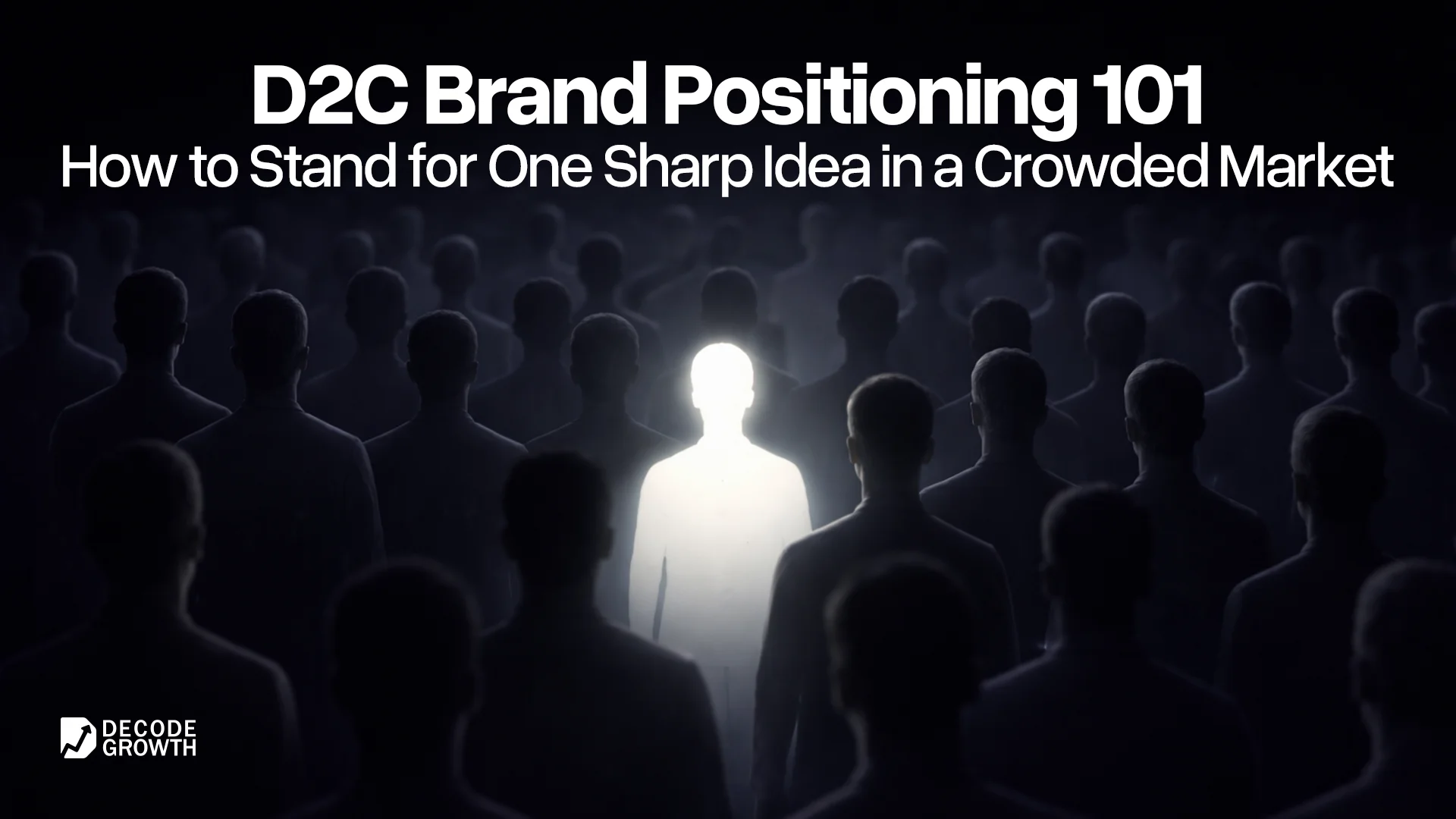
Your D2C brand does not have a visibility problem. It has a positioning problem.
Go to any D2C skincare brand website right now. Read the homepage. Then open three more. You will read “clean ingredients,” “made for Indian skin,” “toxin-free,” and “dermatologist tested” across all of them. The logos are different. Everything else feels the same.
This is the real crisis in Indian D2C branding in 2026. Not competition. Sameness.
The India D2C market is sitting at $108.76 billion this year and heading toward $322 billion by 2031. Thousands of new brands launch every month. But here is the number that should make every founder pause: only 2.1% of D2C brands in India have crossed Rs 150 crore in revenue. The rest are stuck fighting over the same customer with the same message, watching their customer acquisition costs climb 30% year on year with nothing to show for it.
The brands breaking through are not the ones with better products or bigger ad budgets. They are the ones that stand for something specific enough that a particular kind of customer immediately recognizes themselves in it.
The Real Reason D2C Branding Falls Apart
Most D2C founders think their positioning problem is a marketing problem. It is not. It is a clarity problem.
When we ask a founder “what does your brand stand for,” the most common answer is a list. Safe ingredients. Affordable pricing. Good quality. Fast delivery. Sustainable packaging. These are not positions. These are features. And every competitor on the same marketplace listing has the exact same features listed right below yours.
Brand differentiation does not come from doing more things. It comes from meaning one thing so clearly that the right customer feels like the brand was made specifically for them.
Think about how buying decisions actually work. A customer browsing D2C brands is not running a spreadsheet comparison. They are scanning for something that feels like it belongs to their world. The brand that gives them that feeling wins, even if a competitor has a slightly better formulation or a lower price.
Positioning is the feeling before the product.
Every Indian D2C brand has three numbers that determine everything: Read more…
What “One Sharp Idea” Actually Means
A sharp positioning idea is not a tagline. It is not a mission statement written for the about page. It is a specific belief that your brand holds, and that a specific type of customer also holds, so deeply that both you and them would feel uncomfortable doing business with a brand that holds the opposite belief.
That sounds abstract, so let us make it concrete.
A brand that believes “skincare should be boring and scientific, not glamorous” is making a real choice. They are saying no to aspirational photography, celebrity endorsements, and premium unboxing experiences. Their customer is someone who is tired of being sold feelings and wants to be sold evidence. Every product description, every content piece, every customer interaction flows from that one belief.
A brand that believes “fitness is for everyone, not just the already-fit” is making an equally real choice. They are designing for the person who walks into a gym for the first time and feels out of place. Their content shows ordinary people, their product sizing is genuinely inclusive, and their tone never talks down to beginners.
Both of these are sharp ideas. They exclude someone by design, and that is the point. A brand that tries to appeal to everyone ends up meaning nothing to anyone.
The sharpness comes from being willing to turn someone away.
The 3 Questions That Help You Find Yours
At Decode Growth, when we work on brand positioning with D2C founders, we come back to three questions every time. They are simple. Getting honest answers out of them is the hard part.
1 What does your brand genuinely believe that most people in your category would be uncomfortable saying out loud?
Not what sounds good. Not what your investor deck says. What do you actually believe about your customer, your category, or the way this product should exist in someone’s life? The sharper and more specific the belief, the more useful it is.
2 Who is the one person this belief was made for?
Not a demographic. A person. Give them a name in your head. What are they frustrated by? What do they roll their eyes at when they see other brands in your category do it? What would make them send your product to a friend without being asked?
3 If you removed your logo and replaced it with a competitor’s, would this brand still feel different?
This is the test. If the answer is no, you do not have a positioning yet. You have a nice-looking version of the same thing everyone else is doing.
Write your answers to all three. Then read them back. The sharp idea you are looking for is usually sitting inside the answer to question one, waiting for you to trust it enough to build around it.
How mCaffeine Got This Right
There are over 300 D2C personal care brands active in India. Most of them are selling some version of “natural,” “clean,” or “Ayurvedic.” mCaffeine did something different.
They picked one specific, polarizing ingredient, caffeine, and made their entire brand identity around it. Not as a feature buried in an ingredient list. As the brand itself. The name is literally the ingredient.
This is sharp D2C branding done properly. When you think of mCaffeine, you do not think “personal care brand.” You think caffeine-powered skincare for people who are serious about their skin, the way they are serious about their morning coffee. That is a specific person with a specific relationship to an ingredient. The brand did not try to mean everything. It is committed to one thing.
The result is immediate brand recall in a category where most brands blur together. Their content marketing consistently reinforces the caffeine angle. Their product names, their packaging, their social content, their community language, all of it comes back to the same idea. The positioning is not a headline. It runs through everything they do.
That consistency is what builds the customer relationship that turns first-time buyers into repeat buyers without constantly fighting for their attention again.
Turning Your Idea Into a Positioning Statement
Once you have your sharp idea, you need a one-sentence positioning statement that makes it usable. Not for the homepage. For internal clarity. Every product decision, content brief, and customer touchpoint should pass through this statement before it ships.
The formula that works well for D2C brands:
Here is what weak positioning versus sharp positioning looks like using this formula.
Weak: “For health-conscious Indians who want good skincare, BrandX is the personal care brand that makes safe and effective products using natural ingredients.”
Sharp: “For Indian women in their 30s who are tired of aspirational skincare marketing that never explains what anything actually does, BrandX is the skincare brand that treats you like an adult who can read a clinical study.”
The second one is uncomfortable for some people. Deliberately. That discomfort is the brand choosing its customer over trying to keep everyone happy.
Run your own positioning through this test. If a competitor could swap their name into your statement without it feeling wrong, you are not sharp enough yet.
How Content Marketing Locks Your Positioning In
Good positioning is a belief. Content marketing is how you prove you actually hold it.
A D2C brand can claim to believe in ingredient transparency. But if their content is mood-board photography and vague benefit statements, the positioning falls apart at the first touchpoint. The customer came for the promise and found the same thing they see everywhere else.
Brands that use content marketing to reinforce a sharp position build an asset that compounds over time. Every blog post, every Instagram caption, every email that consistently expresses the same belief makes the brand feel more real and more specific. Customers start to feel like they know what the brand would say before they read it. That familiarity is not boredom. It is trust.
Map your content pillars directly to your positioning idea. If your brand believes in science over sensation, your content educates. If your brand believes fitness belongs to everyone, your content shows people at the beginning of their journey, not the end. If your brand believes in sustainability without the guilt-tripping, your content is honest about the trade-offs.
Content that drifts from the positioning, chasing trends, jumping on whatever format is working this week, is slow poison for a D2C brand. It feels productive. It erodes the one thing your brand was trying to own.
Customer Relationship Is Part of Your Brand, Not a Bonus
Here is something most D2C brand positioning guides skip over entirely.
The way you treat customers after they buy is positioning.
Your return policy tells someone whether you trust them. Your response time in DMs tells them whether you see them as a person or a transaction. The way you respond to a negative review in public tells everyone watching what you actually believe about accountability.
Brands like Licious in India understood this early. Their positioning around freshness and quality is not just about the product. It is visible in every customer touchpoint, from delivery packaging to how their support team handles a complaint about a wrong order. The positioning is consistent end-to-end.
A D2C brand that has sharp positioning on the homepage but generic, defensive customer service is sending two contradictory messages. Customers notice the contradiction even if they cannot articulate it. It makes them less likely to repurchase and less likely to refer.
Building a real customer relationship means letting your brand’s belief show up in how you handle things when they go wrong, not just when everything is going right.
Mistakes D2C Founders Keep Making
After working with D2C brands at Decode Growth, the same positioning mistakes keep showing up.
Trying to be premium and affordable at the same time. This is the most common one. Both of those things mean something specific to a customer, and they signal opposite things. Premium says, “We charge more because we are worth more.” Affordable says, “We are accessible to anyone.” Trying to hold both means neither lands.
Building positioning around the product instead of the belief. “We use Himalayan herbs” is a product claim. “We believe Indian beauty rituals deserve modern science behind them” is a positioning. Products can be copied. A belief that runs through everything is much harder to replicate.
Copying a brand that worked and hoping the market is big enough for two. There is one Mamaearth. The market already has one. A second brand that tries to occupy the same belief space is competing on media spend, not positioning, and that is a fight that goes to whoever has more money.
Changing the positioning when growth slows down. This is a trust-killer. If your brand stood for one thing last year and a different thing this year, customers notice. The ones who came for the original positioning leave. The ones you are trying to attract do not yet know you. The brand ends up in no man’s land.
One Thing to Walk Away With
The Indian D2C market is not going to get less crowded. It is going to get more crowded every year as the market grows toward $322 billion by 2031.
The question is not whether your category will have more competition. It will. The question is whether your brand stands for something specific enough that the right customer recognizes themselves in it before they read a single review or compare a single price.
One sharp idea, consistently expressed through your product, your content marketing, and your customer relationship at every touchpoint, is the difference between a D2C brand that keeps buying customers and one that keeps them.
At Decode Growth, D2C brand positioning is one of the core things we work on with founders. If your brand sounds like everyone else in your category right now, that is fixable. But it takes more than a new tagline. It takes a genuine choice about who you are for and who you are not.
FAQs
What is brand differentiation for a D2C brand? Brand differentiation means standing for something specific enough that a particular customer chooses you over a competitor, not just because your product is better, but because your brand feels like it was made for exactly them. It is the belief behind the product, not the features of the product itself.
How do I find the right positioning for my D2C brand? Start with what you genuinely believe about your category that most brands are unwilling to say. Then identify the specific customer who holds that same belief. Your positioning lives at the intersection of those two things. The 3-question framework in this blog is a good starting point.
Can a small D2C brand compete with large ones on positioning? Yes, and this is actually where small D2C brands have an advantage. Large brands have to appeal to everyone. Small brands can afford to mean everything to someone specific. A narrow, sharp positioning is harder to execute for a large brand than it is for a founder who is close to their customer.
How does content marketing support D2C brand positioning? Content marketing is the day-to-day expression of your positioning. Every post, video, email, and product description either reinforces your brand’s core belief or dilutes it. Brands that map their content directly to their positioning idea build recognition and trust faster than brands chasing trends.