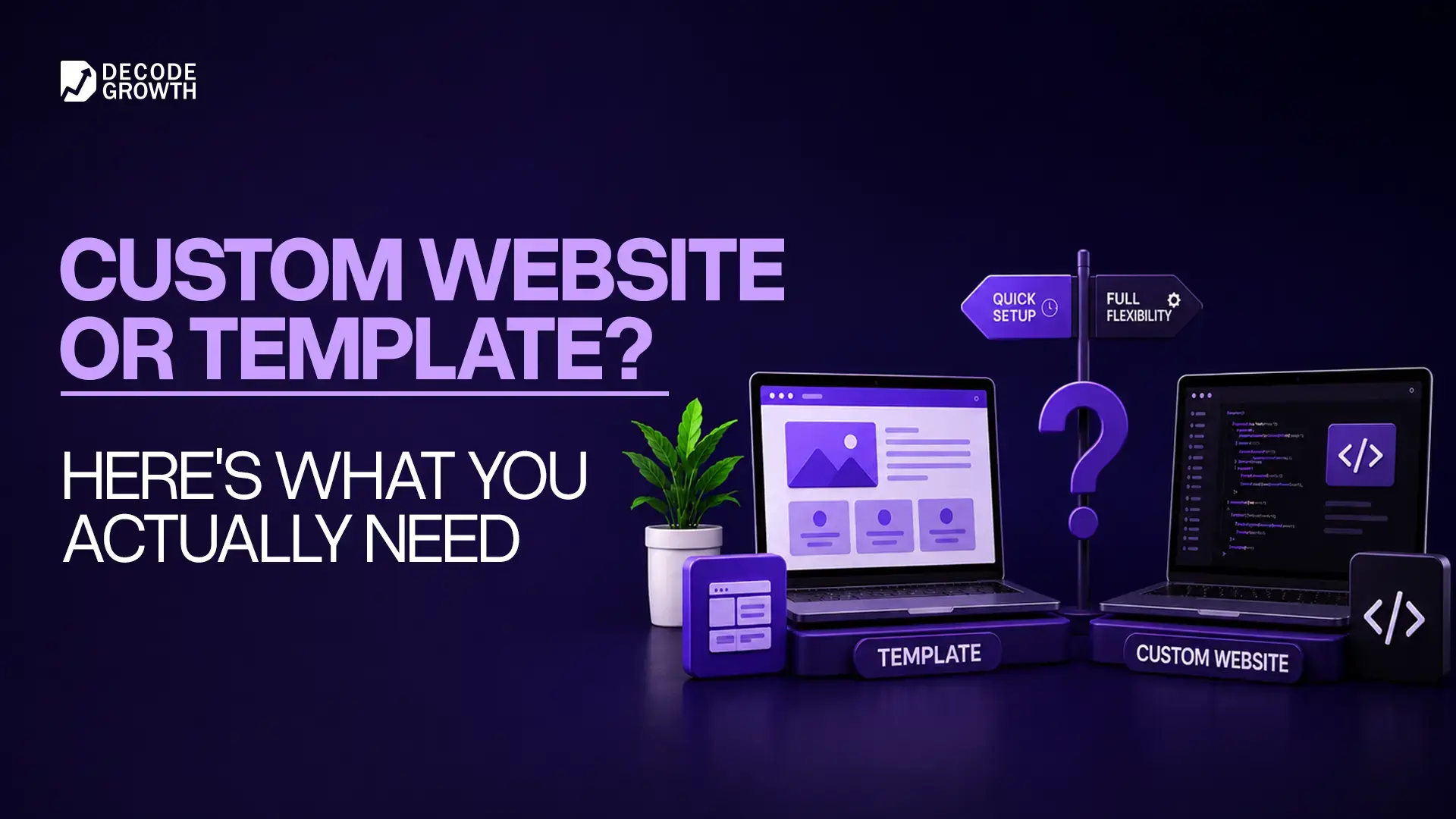
A template might be all you need right now. But if you are losing leads to competitors and your website feels like a digital brochure nobody reads, that is worth paying attention to.
I have had this exact conversation with dozens of business owners. Someone comes in frustrated. Their website looks fine but nobody is calling. Or they are growing fast and their current site cannot keep up. The question they always end up asking is the same one you are probably asking: should I go custom or just stick with a template?
There is no single right answer here, but by the time you finish reading this, you will know which one makes sense for your business specifically.
What You Are Actually Choosing Between
The Template Route
When people talk about a template website, they usually mean something built on Wix, Squarespace, or a pre-made WordPress theme. You pick a design you like, drop in your logo and content, and you are live within days. Maybe even hours.
That is genuinely useful. There is real value in speed, especially when you are testing a new offer, just starting out, or working with a tight budget.
The thing is, when you buy a template, you are buying someone else’s decisions. The layout, the way the menu works, where the sections go, how many columns the page has. All of that was decided by a designer who had no idea what your business does. You are fitting your brand into a box that was built for everyone, which means it was really built for no one in particular.
The Custom Route
A custom website gets built from scratch around your business. Your brand, your customers, the specific way people move through your site before they decide to contact you or buy. None of that gets borrowed from a generic theme.
Custom website development takes longer. It costs more upfront. And yes, you will need a developer to make changes that a template user could probably handle on their own.
But here is what you are actually getting: a website that works like a proper business tool instead of a digital flyer. One that loads fast, looks unlike anything else in your industry, and was designed with a real understanding of how your customers think.
The Real Problems People Run Into with Templates
Nobody talks about this stuff in the first six months. It starts showing up later.
Speed and Performance
Most off-the-shelf WordPress themes and template builders carry a lot of extra code. Animations you are not using. Fonts you never asked for. Scripts running in the background that slow everything down. You probably have not noticed it because you are used to your own site. But your visitors notice. Google notices too.
Page speed is a direct ranking factor. A site that takes four seconds to load on mobile loses more than half its visitors before they even see your homepage. That is not a design problem. That is a code problem, and it is very hard to fix when you are working inside a theme that was not built lean from the start.
A proper custom web design gets built with only what is needed. Nothing extra, nothing borrowed. That keeps load times down and gives you a real advantage in search rankings, especially against competitors running bloated WordPress themes.
You End Up Looking Like Everyone Else
This one hurts more than people admit. There are only so many premium WordPress themes and Squarespace templates out there. Your competitor in the same city, in the same industry, might be running the exact same layout with a different color scheme and a different logo. That is not brand differentiation. That is just redecorating.
When someone lands on your website having just visited three competitors, they notice if everything looks familiar. Custom web design removes that problem entirely because nothing about your site came from a shared pool.
Template Websites Have a Ceiling
At some point, a growing business needs its website to do something the template was never designed to do. A custom booking flow. A specific integration with their CRM. A members’ area that works in a particular way. An e-commerce setup with logic that does not fit into a standard WooCommerce layout.
When you hit that ceiling with a template, your options are ugly. You either pile on plugins and hope they do not conflict with each other, or you pay a developer to hack something together inside a theme that was not meant for it, or you scrap the whole thing and start over anyway. Most businesses end up rebuilding. The template was just a more expensive starting point than it looked.
Custom Website vs WordPress Theme: The Question Inside the Question
A lot of the custom website vs template debate is really about this. WordPress powers over 40% of the internet. It is everywhere. But there is a massive difference between installing a pre-built WordPress theme and having someone build a custom WordPress site for you.
What a Theme Gets You
A good premium WordPress theme with solid plugins can absolutely serve a small business well. You get content management that your team can handle without touching code. You get access to tools like Yoast or RankMath for SEO. You get a community of developers who know the platform inside out.
For a business that mostly needs to publish content, take enquiries, and look professional, this setup works. It is the best website option for plenty of small businesses, especially those not relying heavily on their site to drive revenue.
Where Custom WordPress Development Pulls Ahead
The SEO gap is real, and this is where a lot of businesses do not realize they are leaving money on the table.
A custom WordPress build gives developers complete control over the technical side of things. Clean code structure, proper schema markup for your specific services, optimized CSS delivery, no unnecessary scripts running in the background. When Google crawls a site that is built this way versus one running a feature-heavy theme with fifteen plugins, it notices the difference.
Core Web Vitals, which Google uses as ranking signals, are significantly easier to pass with a custom build. Many popular page builders like Elementor are beautiful to use but they hammer your PageSpeed scores. Hitting 90+ on a heavily themed site requires patching and optimizing after the fact. On a custom build, you are building with performance in mind from day one.
The security picture is also better. Generic WordPress themes are common targets because one vulnerability in a popular plugin or theme can expose millions of sites at once. Custom code does not have that same exposure.
Is a Custom Website Worth It? The Honest Answer
Here is the thing most web agencies will not say clearly: not always.
When a Template Is the Right Call
You are just getting started and need something online to test your idea. Your website is not your main source of leads; it is more of a reference point for people who already know you. You have a limited budget and other areas of the business need that money more right now. You need to be live within days, not weeks.
In these situations, a template website for small business use is not a compromise. It is a sensible business decision. Launch with what you can afford. Figure out what your website actually needs to do. Then invest in the right thing at the right time.
When Custom Website Development Makes the Business Case
You are spending money on ads and a slow or generic site is killing your conversion rate. Your competitors have strong websites and you are losing work because yours does not measure up. You have a specific process, service, or product that needs to be communicated in a way no template does justice to. You are scaling and need your website to handle more traffic, more functionality, and tighter brand control. You are serious about SEO and want to rank for competitive terms in your industry.
At this point, custom website development stops being an expense and starts being an investment. The ROI conversation changes completely when your website is actively generating business instead of just sitting there.
The Cost Conversation People Avoid
Custom websites are more expensive upfront. That is just true. But the total cost of owning a template website over five years is often closer to custom than people expect. Monthly platform fees, premium plugin licenses, theme update conflicts, security monitoring, and the developer time spent fixing things that break during updates add up quietly. A well-built custom website has its own maintenance costs, but they are more predictable and less chaotic.
How to Actually Make This Decision for Your Business
Stop thinking about it as a custom website vs a template as an abstract debate. Think about your specific situation.
The Questions That Actually Matter
What is your website supposed to do for your business right now? If the honest answer is “give people our phone number and show we exist,” a template does that. If the answer is “convert visitors into paying clients and rank above our competitors,” the bar is higher.
How competitive is your market online? Search your main service and location. Look at what is ranking. If every result is a polished, fast, well-designed site and you are running a basic theme, that gap is visible to every potential customer who finds you.
Are you hitting limitations with your current setup? If you are already frustrated with what your template cannot do, that frustration gets worse, not better. You are probably past the point where patching it makes sense.
What does the next three years of your business look like? A website that works for you today but cannot grow with you is going to need replacing anyway. Building something scalable now can be cheaper than rebuilding later.
The Middle Ground More People Should Consider
Not every business needs to choose between a starter template and a fully bespoke build costing tens of thousands. A custom-developed WordPress site built by someone who knows what they are doing sits right in the middle. Lightweight code, no unnecessary theme baggage, built around your actual requirements, and still running on a CMS your team can manage.
This is genuinely the best website option for a lot of growing small businesses. It gives you the performance and flexibility of custom website development with the manageable backend of WordPress. It is not a compromise. It is just a smarter way to spend the budget.
Five Questions People Always Ask About This
Yes. A template website can rank, and plenty of them do. The challenge is that most templates carry performance baggage that makes it harder to compete on technical SEO. If you optimize carefully, choose a lightweight theme, and keep plugins minimal, you can do well. But in competitive niches, the performance ceiling of a template can hold you back in ways a custom build would not.
A WordPress theme gives you a pre-designed structure you fill in. A custom website is built around how your specific business works and how your specific customers think. The design is different, but more importantly the code is leaner, the performance is better, and nothing about it was borrowed from a template built for a different kind of business.
It varies a lot depending on complexity, but a straightforward custom website for a service business typically starts somewhere in the thousands and goes up from there based on features and scope. That feels like a lot until you compare it against what poor online visibility is actually costing you in lost business.
If your budget is genuinely tight, start with a solid template and use the money elsewhere in your business. Revisit the custom route once your revenue supports it. The worst outcome is spending heavily on a custom build before you know exactly what you need it to do. Get some traction first, then build properly.
You can keep your domain, your content, and your brand. But in most cases you are rebuilding the website itself from the ground up. The template and the custom site are built differently enough that migrating piece by piece rarely makes sense. Think of it less like renovating and more like moving into a better building.