In 2023, thousands of Indian websites did something that felt like a breakthrough.
They used AI tools to publish 15, 20, sometimes 50 blog posts a month. Traffic climbed. Rankings improved. The SEO strategy seemed to be working.
Then came 2024. And 2025. And the updates that quietly erased all of it.
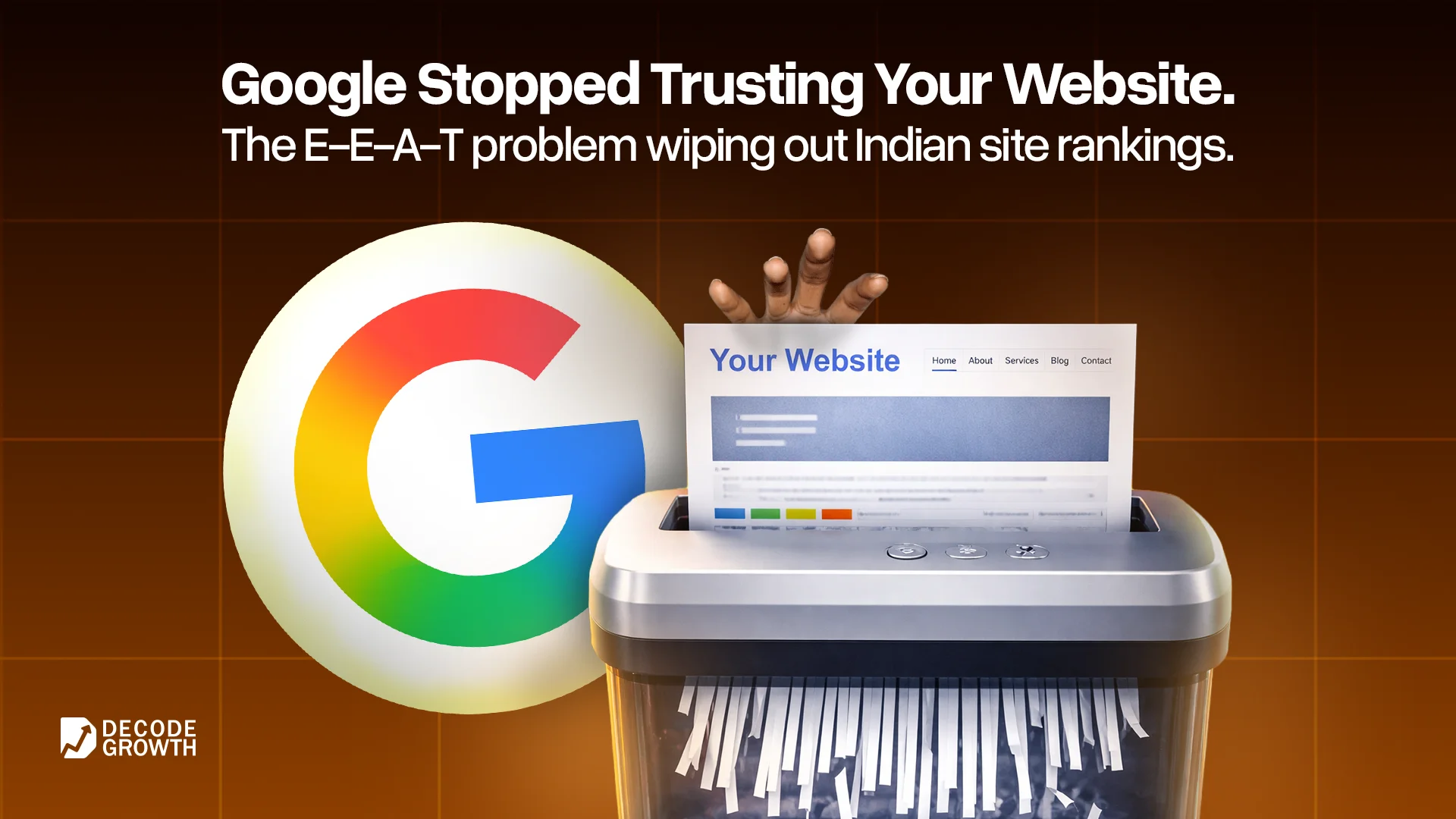
Google’s algorithm updates between 2024 and 2026 focused heavily on trust signals, and the businesses dominating search today are not the ones who published the most content. They are the ones who built the strongest case for why Google should trust them.
Indian websites hit hardest by these updates shared one profile. High content volume. Generic writing that could apply to any business in any country. No named authors. No data citations. No real-world experience visible anywhere on the page. In digital marketing terms, these sites had visibility without credibility, and Google systematically dismantled the gap between the two.
That gap has a name. It is called Google E-E-A-T.
If your digital marketing results have stalled, your rankings have slipped, or your organic traffic has dropped in the last 12 to 18 months without a clear technical reason, this is almost certainly why. And the fix is more straightforward than most agencies will tell you.
What Does Google E-E-A-T Actually Mean?
E-E-A-T stands for Experience, Expertise, Authoritativeness, and Trustworthiness. It comes directly from Google’s Search Quality Rater Guidelines, a 170-page document that Google uses to train human evaluators who assess search result quality.
The fourth E, Experience, was added in December 2022. Before that, the framework was simply E-A-T. The addition of Experience was not cosmetic. It fundamentally shifted what Google rewards. The question was no longer just “does this person know their subject?” It became “have they actually done it?”
Here is what each letter means in plain language, and why each one matters specifically for Indian websites and digital marketing practitioners.
Experience: Have You Actually Done What You Are Writing About?
Experience is the most misunderstood part of Google E-E-A-T.
Here is the simplest way to understand it. A blog post about “how to build a digital marketing strategy” written by someone who has never actually built one for a real client has zero Experience signal. The same post written by someone who ran a campaign for a Mumbai D2C brand, hit audience fatigue in month two, switched to UGC creatives, and documented the ROAS recovery, that is Experience.
Google’s systems are looking for details that only come from actually doing the work. Specific timelines. Real obstacles. Outcomes tied to real decisions. Generic advice that could apply to any business anywhere does not qualify.
This is a genuine opportunity for Indian agencies and businesses. Content that mentions Shiprocket RTO rates, Razorpay COD conversion issues, or festive season traffic patterns is signalling to Google that a real practitioner wrote this, not a content tool that has never worked with an Indian client.
We audited a Delhi-based educational blog last year. Thirty-four of their forty-seven posts had no India-specific examples, no real results, no named author. After Google’s August 2024 core update, they lost 52% of their organic traffic in sixty days. The content was not wrong. It just had no proof of experience behind it.
Expertise: Stop Hiding the People Behind Your Content
If your posts are published under “Admin” or “Team”, you are hurting your Google E-E-A-T every single time you publish.
Expertise is not about sounding authoritative. It is about being clearly identifiable as qualified. A named author with a real bio, a LinkedIn profile that matches, and a history of writing on the same topic is what Google is looking for.
The best SEO strategy for small businesses in India is not writing more. It is writing less but making sure every piece has a real person’s name on it who can be verified independently.
One important thing: expertise requirements are not the same for every topic. A lifestyle blog does not need a certified expert. But content covering digital marketing strategy, financial advice, legal guidance, or health information falls into what Google calls YMYL, Your Money Your Life, and they are held to a much higher standard because bad advice in these areas causes real harm to real people.
Authoritativeness: What the Rest of the Internet Says About You
Authority is not built on your own website. It is built by what others say about you outside it.
One genuine mention in a publication your ideal customer trusts, Economic Times, YourStory, Inc42, does more for your SEO strategy than fifty directory links from sites nobody has heard of. The quality of the mention matters far more than the quantity.
For Indian businesses, authority also shows up in verified client case studies, Google reviews from real customers, and founder quotes in relevant publications. A simple press page on your website collecting every media mention, award, and podcast appearance takes one afternoon to build and sends a signal Google can verify independently that your brand exists and has been recognised outside its own walls.
Trustworthiness: The Layer Everything Else Sits On
Google describes Trustworthiness as the most important of all four E-E-A-T components. You can have experience, expertise, and authority, but if your site does not feel safe and transparent, none of it matters.
The most common trustworthiness failures on Indian websites look like this. An About page with no real people named. No address or phone number. Every blog post published by “Admin.” Bold claims like “best digital marketing agency in India” or “guaranteed rankings” with nothing backing them up. Privacy policies copied and pasted from a template. HTTP instead of HTTPS.
Each of these is a small leak. Together, they tell Google, this may not be a real, accountable business. And once Google decides that, no amount of keyword optimization brings the traffic back.
The 5-Step Fix: How to Rebuild Google E-E-A-T on Your Indian Website
Every one of these steps is actionable today. None requires a developer. None requires a redesign. They require honesty about what your current content is actually demonstrating.
Step 1 – Add Real Author Bios to Every Post and Page
This is the fastest Google E-E-A-T win available and it takes less than two hours to implement across your entire site.
Change every post from “Admin” or “Team” to a real person’s name. Create a proper author bio page for each person covering their actual credentials, years of digital marketing or relevant experience, the industries they have worked in, specific companies they have worked with, a professional photo, and a link to their LinkedIn profile. Add a short version of this bio at the bottom of every post they have authored.
The bio must answer three questions: who is this person, why are they qualified to write about this topic, and where can Google verify that they exist independently of your website. The LinkedIn link is the verification layer. It transforms an author from a name on your site into a real person with a public professional profile that Google can cross-reference as part of its entity evaluation.
Step 2 – Cite Sources for Every Factual Claim
Read through your existing content and identify every statistic, percentage, market size figure, or behavioural claim that has no source link. These unsourced claims are one of the most common trust signals Google’s quality evaluators flag as weak.
Credible Indian sources for citation in a digital marketing or SEO strategy blog include Think with Google India reports, NASSCOM data, Inc42 research, Economic Times market analyses, and DPIIT industry reports. Each citation you add converts a claim from “this is what we think” to “this is what the data shows”, a fundamental shift in how Google evaluates the page’s trustworthiness.
Step 3 – Delete or Rewrite Thin AI Content Immediately
Open Google Search Console. Go to the Performance report. Sort by impressions. Find every page that has received more than 100 impressions but fewer than 5 clicks in the last six months. These are pages Google is surfacing but users are actively rejecting, a clear signal that the content does not match search intent or does not feel credible enough to click.
For each page, make a binary decision. Rewrite it with a named author, real examples from your actual work, India-specific data, and genuinely new information. Or delete it and redirect the URL to the most relevant remaining page. Keeping thin or outdated content on your site does not just hurt those individual pages. It drags down the overall quality signal for your entire domain, meaning your best content ranks lower because your weakest content is pulling down the site-wide trust assessment.
Step 4 – Add First-Person Experience to Every New Piece of Content
Every new blog post published from today should contain at least one element that could only come from actually doing the thing you are writing about.
For a digital marketing agency, this means sharing specific, real results, even without naming the client. “A Bangalore-based B2B software company we worked with in early 2026 was ranking on page three for their primary service keyword. We restructured their content around topical authority in their specific niche, added author credentials to every post, and implemented FAQ schema. In 90 days, they moved to position four on page one, and their organic leads increased from three per month to seventeen.”
That is Experience. It is specific. It names a city, a timeline, a tactic, and a measurable outcome. It could not have been written by an AI tool that has never run an SEO strategy for a real Indian business. This is precisely the kind of content that Google E-E-A-T is designed to identify and reward.
Step 5 – Build Social Proof That Google Can Verify Independently
Reviews, case studies, client logos, and media mentions are not just conversion tools. They are trust signals that Google can verify from sources other than your own website, which is exactly what Authoritativeness requires.
Send a review request via WhatsApp or email within 24 hours of a positive customer interaction. Aim for a minimum of 50 verified reviews with a 4.5 plus star average on your Google Business Profile. Respond to every review, positive and negative, within 24 hours. Your response to a negative review is often more important than the review itself, because future customers read it to judge how you handle problems.
For every case study you publish, include the challenge, the specific digital marketing or SEO strategy approach, the tools used, and the measurable results. Link these case studies from your blog posts wherever the topic connects. Over time, this web of verified proof creates the kind of reputation signal that no amount of keyword optimisation can replicate.
Google E-E-A-T Is Now the Core of Every Effective SEO Strategy in India
The most important shift in digital marketing SEO over the last two years is not technical. It is credibility-based.
The best SEO strategy for small businesses in India in 2026 is not a keyword strategy or a backlink strategy. It is a trust strategy. It is building a website where every page, every post, and every profile, including your Google Business Profile, sends a consistent signal that a real, qualified, experienced person or team created this content, stands behind it, and can be verified independently.
The businesses dominating search today are simply better structured. Clear relevance. Strategic authority. Compounding trust. Consistent information across every platform. The businesses that rely on shortcuts see that visibility fade. The ones building genuine credibility see it compound.
Indian websites that rebuild their Google E-E-A-T foundation, with named authors, cited data, real experience signals, optimised GBP, and consistent social proof, will recover their traffic and outrank competitors who are still producing volume without credibility.
The ones that do not will keep watching their traffic drop and keep wondering why.
Is Your Website Sending the Right Trust Signals to Google?
Most Indian business websites are not. The traffic numbers are showing it clearly. The good news is every Google E-E-A-T gap is fixable without a redesign, without a developer, and without starting over.
Fixing E-E-A-T is not a one-time task; it is an ongoing content and SEO strategy that compounds over time. At Decode Growth, we build and execute SEO strategies for businesses that are built around credibility, topical authority, and content that actually ranks. If you want an agency that understands both the technical and the human side of Google rankings in India, let us talk.
FAQS
Google E-E-A-T – Experience, Expertise, Authoritativeness, Trustworthiness, is how Google decides whether your content deserves to rank. After the 2024 and 2025 core updates, Indian websites that published AI content without real authors, real data, or real experience lost 40 to 60% of their organic traffic. It is no longer enough to have the right keywords; Google now needs proof that a qualified person wrote it.
The most common cause is weak E-E-A-T signals – no named authors, no cited data, and thin content that adds nothing new to what already exists on Google. Open Search Console, find pages with high impressions but low clicks, and that is your problem list. The fix is not more content – it is making your existing content credible.
Yes, directly. Google uses your Google Business Profile as an independent trust verification source alongside your website when evaluating local rankings. Reviews, accurate business details, regular posts, and consistent NAP data across directories all strengthen the Trustworthiness component of your E-E-A-T.
Five steps in order of impact: add named author bios, cite sources for every claim, delete thin AI pages, add first-person experience to new content, and build Google reviews consistently. Combining these website fixes with a fully optimised Google Business Profile is the most complete E-E-A-T strategy available to Indian small businesses right now.
Not automatically, Google penalises low-quality, experience-free content regardless of how it was produced. AI content that is edited by a named expert, grounded in real India-specific data, and published with proper author credentials can rank well. What gets penalised is unedited AI content with no human expertise, no citations, and no accountability behind it.