India’s D2C market is exploding. From ₹33.1 billion in 2020 to an estimated $100 billion by 2025, D2C brands in India are rewriting the rules of commerce. Over 800 funded brands now compete for consumer attention in a market projected to hit $300 billion by 2030.
But here’s the uncomfortable truth most D2C brands won’t admit: 58% of them cite copycat competitors as their biggest challenge. Only 34% successfully retain customers beyond five years. In a market drowning in options, growth isn’t the problem, trust is.
This isn’t about having the cheapest product or the loudest marketing. It’s about solving the fundamental equation that separates fleeting businesses from generational brands This blog will tell you what exactly you need to do to scale your D2C brand.
What Actually Drives Trust in D2C
Trust isn’t built through marketing slogans or influencer partnerships. It’s built through a consistent pattern of delivered promises. The top D2C brands in India, Lenskart, boAt, Licious, Mamaearth, all share a common DNA: they obsess over product quality first, marketing second.
This inverts the typical D2C marketing strategy playbook. Most brands think: “How do we market this product?” The winning brands ask: “How do we make this product so good that marketing becomes easier?”
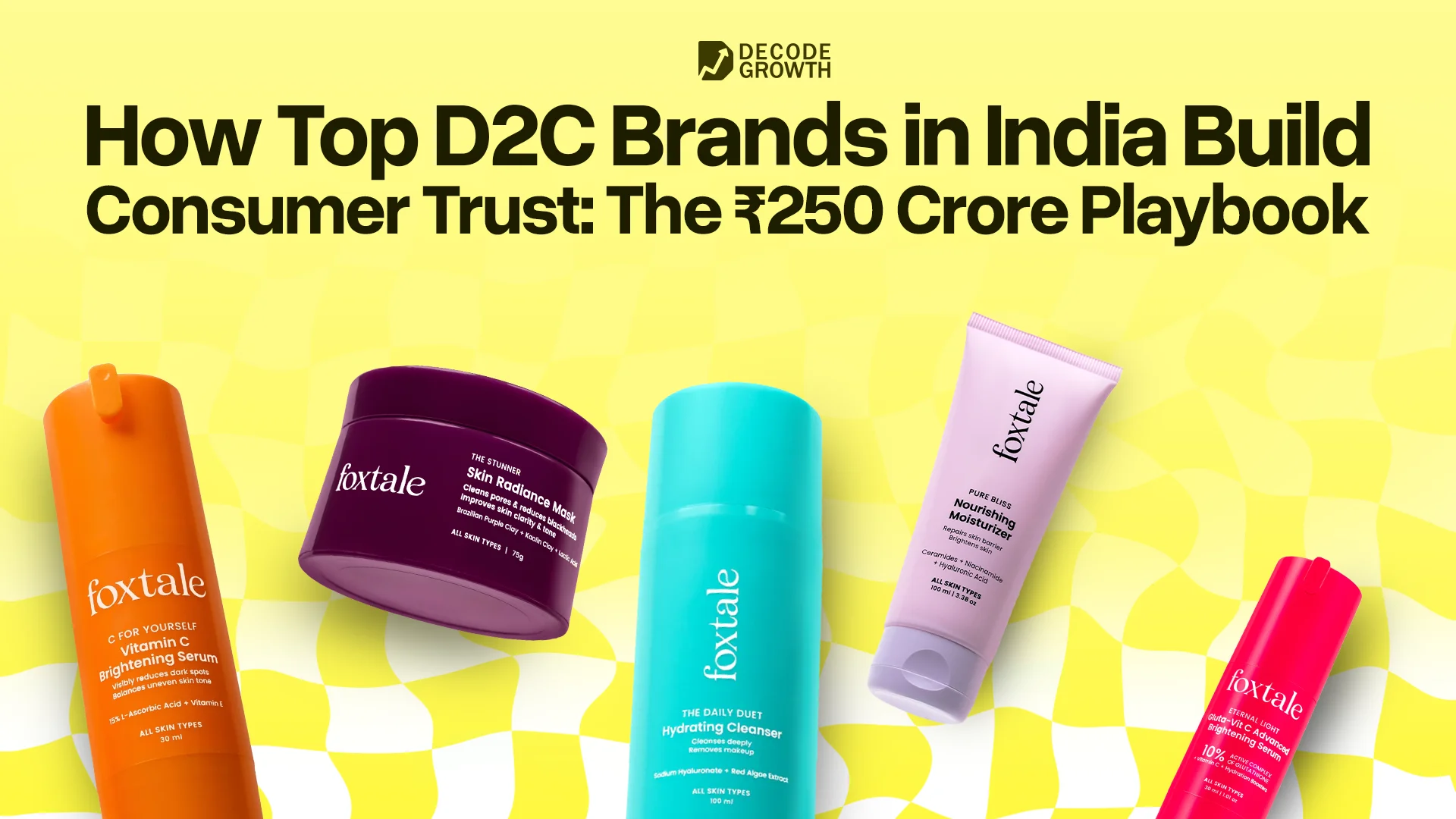
When Foxtale launched, they confused industry insiders by starting with just 4 SKUs. Most beauty brands launch with 15-20 products to give customers choice. Today, Foxtale still maintains only 18-25 SKUs while competitors carry 50-100.
Why does this matter? Because fewer products allow deeper focus. Their internal rule, no product launches without 97% community approval, isn’t marketing theater. It’s operational discipline that builds trust through consistently excellent products.
The result? Revenue run rate of ₹240-250 crores with 500,000+ customers across 100+ cities. All built on trust first, scale second.
The Customer-First Research Framework
Before building anything, understand everything. This isn’t revolutionary advice, but it’s rarely executed properly. Most D2C brands conduct market research as a formality, send out a survey, talk to 20 people, call it done.
Real customer research looks different. Romita spent six months having deep conversations with 900+ women. Not structured surveys. Real conversations exploring frustrations, past attempts, what actually worked. From Ranchi to Mumbai, college students to working mothers, she discovered patterns that surveys would never reveal.
The insight wasn’t “women want better skincare.” That’s obvious. The insight was “women don’t trust brands because nothing delivers visible results fast enough.” That specificity, visible results, fast timeline, became Foxtale’s entire product philosophy.
For your D2C business, this means investing time before investing capital. Talk to 50 customers minimum before building your next feature. Ask what frustrates them about current solutions. What they’ve tried. What actually worked. Listen for patterns, not individual opinions.
The Credibility Factor: Expert Validation Matters
In markets drowning in options, credibility breaks through noise. Foxtale’s co-founder Dr. Ramesh Surianarayanan wasn’t just a formulator, he was a living legend who’d created Fair & Lovely at Hindustan Unilever and led R&D at Himalaya. His involvement wasn’t just about making good products. It was a credibility signal that built instant trust.
This principle applies beyond skincare. When consumers evaluate D2C brands in India, they’re asking: “Why should I trust you over established options?” The answer can’t just be “we’re cheaper” or “we’re online.” It needs to be rooted in demonstrable expertise.
For a fashion brand, maybe it’s a designer with prestigious credentials. For a food brand, perhaps a chef with Michelin experience. For tech products, an engineer with patents. The specific expertise matters less than its relevance and verifiability.
This is where strategic partnerships with a digital marketing company in Delhi or your local market become valuable. Professional marketing teams help identify and amplify your credibility signals, whether that’s founder expertise, manufacturing partnerships, certifications, or customer testimonials from credible sources.
Distribution Strategy: Meet Customers Where They Shop
Foxtale’s revenue breakdown reveals smart distribution thinking: 50% from D2C website, 40% from online marketplaces (Nykaa, Amazon, Flipkart, Myntra, Blinkit), 10% from offline retail.
This omnichannel approach contradicts purist D2C philosophy that says “own the customer relationship completely.” But pragmatism wins. If customers already shop on Nykaa or Amazon, being available there isn’t dilution, it’s smart customer acquisition.
The key is channel economics. Own website sales offer better margins and first-party data. Marketplace sales provide volume and discovery. Offline retail builds brand credibility and serves customers who prefer trying products physically.
Top D2C brands in India like boAt and Mamaearth follow similar strategies. They started D2C, scaled through marketplaces, then added selective offline presence. This mirrors global success stories like Warby Parker and Glossier.
For your business, this means resisting channel purity for practical growth. Start D2C to control brand experience and collect customer data. Expand to marketplaces for scale and visibility. Add offline strategically once brand recognition justifies retail partnerships.
Strategic social media marketing services help optimize this distribution mix by identifying which channels drive highest-quality customers, then allocating marketing spend accordingly across the funnel.
The Role of Social Proof in D2C Trust Building
In digital commerce, social proof replaces in-store trials. When customers can’t touch products physically, they rely on others’ experiences. This makes reviews, testimonials, and user-generated content critical trust signals.
The most effective D2C marketing strategies treat social proof as product, not afterthought. Foxtale’s 97% community approval threshold before launching products isn’t just quality control, it’s social proof generation. Those early advocates become authentic testimonials.
According to consumer research, 91% of customers prefer brands offering personalized experiences. But personalization at scale requires data from customer interactions. D2C models enable this through direct relationships, creating feedback loops that traditional retail can’t match.
For implementation, this means actively collecting reviews, showcasing real customer results (photos, videos, detailed testimonials), responding to all feedback publicly, creating communities where customers interact, and highlighting user-generated content across marketing channels.
Professional SMO digital marketing teams excel at amplifying social proof across platforms. They identify your strongest testimonials, optimize them for different channels (Instagram, website, email), and create systems for continuous collection and display.
Why Partner With a Digital Marketing Company That Understands D2C
The challenge with D2C marketing is it requires different expertise than traditional brand marketing. You’re not just building awareness, you’re building an entire customer journey from discovery through repeat purchase.
Most agencies excel at one piece: performance marketing teams optimize acquisition, brand agencies create beautiful campaigns, SEO specialists drive traffic. But D2C brands need integrated thinking across the entire lifecycle.
At Decode Growth, we’ve built our approach specifically around D2C economics. We don’t just ask “How do we get more traffic?” We ask “How do we build trust that converts traffic into loyal customers?” That shift in framing changes everything.
We work with D2C brands in India across categories, fashion, beauty, food, electronics, wellness. Our methodology starts with understanding what makes your business genuinely trustworthy, then building marketing systems that amplify those trust signals at every customer touchpoint.
This means deep research into where your customers authentically engage, not just where ads are cheapest. It means identifying differentiation that creates natural conversation, not just competitive positioning. It means building retention mechanisms that turn customers into advocates.
Final Perspective: Trust as Competitive Moat
In a market where 800+ funded D2C brands in India compete for attention, and 58% cite copycat competitors as their biggest challenge, trust becomes the only sustainable differentiation.
Products can be copied. Marketing tactics spread quickly. Distribution advantages are temporary. But customer trust, earned through consistently delivered promises, creates a moat that’s extremely difficult to breach.
Foxtale’s ₹250 crore raise wasn’t celebrating their product innovation or marketing creativity. It was recognizing they’d built something more valuable: 500,000+ customers who trust them enough to keep returning. That 50%+ repeat rate represents millions in future revenue that’s dramatically cheaper to capture than new customer acquisition.
The question for your D2C business isn’t “How do we grow faster?” It’s “How do we build trust that makes growth inevitable?”
Because in 2026 and beyond, the D2C brands still standing will be the ones customers couldn’t imagine leaving. Not because switching costs are high, but because trust and satisfaction make looking elsewhere unnecessary.That’s the game. That’s what separates temporary businesses from generational brands.
Ready to Build a D2C Brand That Customers Trust? Book a call today!